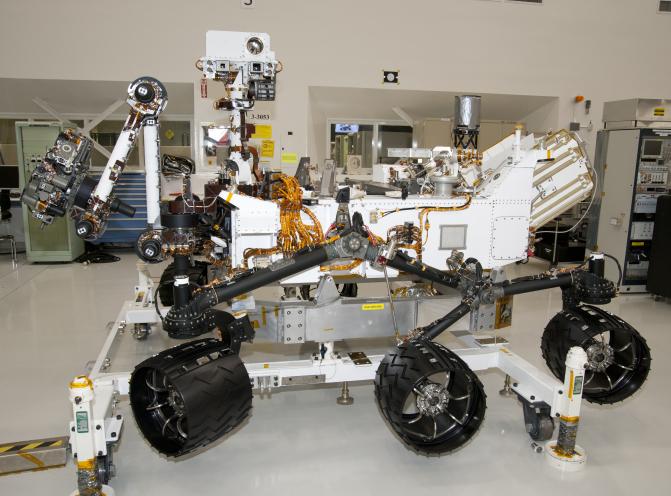
NASA's next Mars rover, Curiosity, is near completion. Part of NASA's
Mars Science Laboratory Spacecraft, engineers have assembled and tested nearly all the rover's components at the Jet Propulsion Lab in California.
 |
| Credit: NASA/JPL-Caltech |
In May and June the rover and other components of the spacecraft will be shipped to the Kennedy Space Center in Florida, where it will be prepared for launch. The launch will have to take place somewhere between Nov. 25 and Dec. 18, 2011, when the spacecraft can most effectively reach Mars. The launch vehicle to be used is an Atlas V rocket, on which the spacecraft will be bolted to the top.
 |
| Credit: NASA/JPL-Caltech |
These images are essentially how the rover will look when it lands on Mars in August 2012. The mission will last for at least two earth years, but given the high mileage we have gotten out of the last two rovers (Spirit and Opportunity), this one has a lot of hope for more.
The landing-site is still to be selected among four finalist candidates, but the rover is equipped to study the intriguing places on Mars. At about 3 meters in length, the size of a Mini-Cooper (a small British-made car), the Curiosity rover is equipped with 10 scientific instruments to analyze Martian rock and soil. It will look for evidence of if Mars has ever offered environmental conditions favorable to microbial life in the past or present.
The decision on a landing-site is a matter of what area is most likely to be habitable. A sort of 'habitable zone' for Mars' surface. This would also help our own understanding on life's limits within our solar system. The problem with selecting a site also becomes an issue between researchers and engineers. The researchers, of course, want to research every nook and cranny and examine the most challenging places. The engineers can only build something that can do so much and go so far. There needs to be a broad open area to land a craft, and often that knocks out most of the interesting regions. Part of the reason some of the previous Mars photos looked like deserts was because the craft landed in a Martian desert.
 1:17 AM
 Astronomy Pirate
 Posted in




 .
.