2:31 AM
 Astronomy Pirate
I felt like I haven't done a good astrobiology article in awhile. And I wanted to do something a bit different then the normal way we tend to think about life in the Universe. This one is about life on Mars, but in a different sense. It also pulls on an idea I talked about in the Life on Ceres article from a couple weeks back.
Lets just go ahead and throw the big-worded-phrase out there: Unintentional Anthropogenic Panspermia. More simply: human activity might have accidentally brought life to another planet. Specifically, Mars in this case.
OK? Yeah, it is kind of a crazy idea, along with lots of questions of hows and whys. But, like the classic idea of panspermia (that life on Earth was formed somewhere else and seeded here through natural [meteor, asteroid, or comet impact] causes), this idea is purely conjecture. It stands as a pretty fun thought in some astrobiologist heads since there is no way to determine anything definitive right now.
Unlike the idea of the Earth being seeded with life, if humans unintentional brought life to Mars, we may be able to prove it... eventually.
First, lets take a step back and figure out how exactly Earth-based lifeforms would have made it to Mars. It is a bit ironic that the first missions being sent to Mars to search for life, might have been the ones to have brought it there. After it was clear that the United States had one the race to the Moon in 1969, the Soviet Union turned its eyes towards Mars. A red planet for the red army, the space race was still on.
It turns out that getting to Mars, even with just a probe, was more expensive and difficult than putting a man on the Moon. And if getting there was hard, putting a lander on the surface was even harder. There were numerous failed missions, some of which barely got off the launch platform, others missed Mars entirely and sailed of into space, never to be heard from again.
A few of those probes actually made it to Mars, and the Soviet Union had managed to get six landers to Mars before the famous USA Viking mission. They were known as Mars 2-7 (Mars 1 failed during launch). These were actually fairly sophisticated landers for the time, but they involved little more then crashing a probe into the planet and seeing how long it would last. They didn't provide the wealth of information that the highly successful Viking mission did, but they were many properties of Mars that were previous unknown.
Unfortunately, after this point, the USSR was beginning to run into problems with its space program. They had already been cutting corners, which was beginning to show with the multiple launch failures. But all these failures and the faltering politics brought to an end some of the most ambitious Mars missions on the chalkboard, including sample returns. Since the fall of the Soviet Union, there has been only one failed attempt by Russia to return to Mars, but there are currently plans for a lander on Mars' moon Phobos that will return samples.
So that is a little bit of the early Mars exploration history, with a larger context on Soviet activities. There is a specific reason why to highlight those missions, Mars 2-7. With the exception of 4 and 7, they all made it to the Martian surface. And I also mentioned that the Soviets had been cutting corners. See, they didn't have quite the same idea of procedure we have today. These landers were often poorly decontaminated, if at all. They were likely crawling with microorganism.
Before I have mentioned just how extreme and hardy life can be. This could very well be the case, that some amazing extremophile from our Earth survived a 60 million kilometer trip that lasted months to the surface of Mars. It sounds amazing, it sounds fantastic, it sounds plausible! In the crater of some old Soviet probe in the middle of the cold, dusty Martian desert there could be life from our muddy blue marble, so far from home.
How would our distance brothers be doing? That is a point of contention. The probes could have been entirely sterilized from solar and cosmic activity. Or the microorganisms could still be in a frozen hibernation that they have been in since launch, waiting for the right conditions. Or they might have found just the littlest amount of liquid water nearby and have created a thriving community around the landing site, perhaps even seeping deep into the warmer crust.
If our brothers from Earth have flourished underground, they might have found Martian life not to different from themselves. A recent finding of 'worms' deep in the Earth's crust provides hope for life in similar environments on Mars and other locations. There could be a proverbial 'War of the Worlds' going on between tiny Soviet invaders and native Martians. This is also part of the reason why there is a push for decontamination these days, to not destroy any potential life that might exist or ruin alien environments.
Like I said before, this is conjecture, but it is entirely plausible. And it is testable. If we get to Mars and discover life, it would be fairly simple to determine if the similar to modern Earth-based lifeforms. They would likely carry signatures similar to all other life on Earth, unlike something that developed in a totally isolated Martian environment, which would expect to have a markedly different genetic history.
Lets just go ahead and throw the big-worded-phrase out there: Unintentional Anthropogenic Panspermia. More simply: human activity might have accidentally brought life to another planet. Specifically, Mars in this case.
OK? Yeah, it is kind of a crazy idea, along with lots of questions of hows and whys. But, like the classic idea of panspermia (that life on Earth was formed somewhere else and seeded here through natural [meteor, asteroid, or comet impact] causes), this idea is purely conjecture. It stands as a pretty fun thought in some astrobiologist heads since there is no way to determine anything definitive right now.
Unlike the idea of the Earth being seeded with life, if humans unintentional brought life to Mars, we may be able to prove it... eventually.
 |
| Mars: frozen desert or thriving ecology? (Image Credit: Spirit Rover, NASA) |
First, lets take a step back and figure out how exactly Earth-based lifeforms would have made it to Mars. It is a bit ironic that the first missions being sent to Mars to search for life, might have been the ones to have brought it there. After it was clear that the United States had one the race to the Moon in 1969, the Soviet Union turned its eyes towards Mars. A red planet for the red army, the space race was still on.
It turns out that getting to Mars, even with just a probe, was more expensive and difficult than putting a man on the Moon. And if getting there was hard, putting a lander on the surface was even harder. There were numerous failed missions, some of which barely got off the launch platform, others missed Mars entirely and sailed of into space, never to be heard from again.
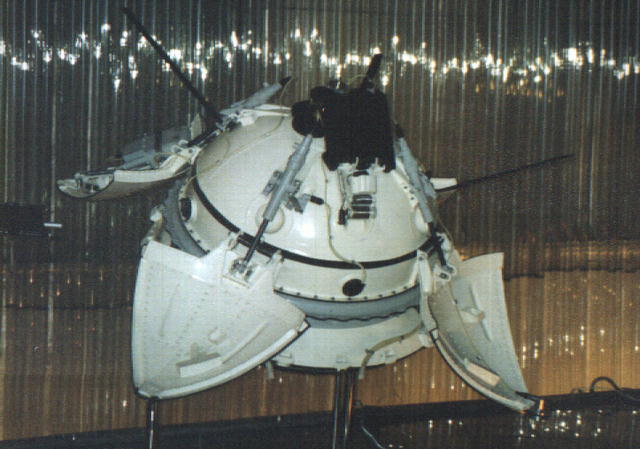
A few of those probes actually made it to Mars, and the Soviet Union had managed to get six landers to Mars before the famous USA Viking mission. They were known as Mars 2-7 (Mars 1 failed during launch). These were actually fairly sophisticated landers for the time, but they involved little more then crashing a probe into the planet and seeing how long it would last. They didn't provide the wealth of information that the highly successful Viking mission did, but they were many properties of Mars that were previous unknown.
 |
| Mars 3 Lander model at the Memorial Museum of Cosmonautics in Russia. (Source) |
Unfortunately, after this point, the USSR was beginning to run into problems with its space program. They had already been cutting corners, which was beginning to show with the multiple launch failures. But all these failures and the faltering politics brought to an end some of the most ambitious Mars missions on the chalkboard, including sample returns. Since the fall of the Soviet Union, there has been only one failed attempt by Russia to return to Mars, but there are currently plans for a lander on Mars' moon Phobos that will return samples.
So that is a little bit of the early Mars exploration history, with a larger context on Soviet activities. There is a specific reason why to highlight those missions, Mars 2-7. With the exception of 4 and 7, they all made it to the Martian surface. And I also mentioned that the Soviets had been cutting corners. See, they didn't have quite the same idea of procedure we have today. These landers were often poorly decontaminated, if at all. They were likely crawling with microorganism.
Before I have mentioned just how extreme and hardy life can be. This could very well be the case, that some amazing extremophile from our Earth survived a 60 million kilometer trip that lasted months to the surface of Mars. It sounds amazing, it sounds fantastic, it sounds plausible! In the crater of some old Soviet probe in the middle of the cold, dusty Martian desert there could be life from our muddy blue marble, so far from home.
 |
| Tardigrade, AKA Water Bear, AKA the baddest animal on Earth, and maybe Mars. |
How would our distance brothers be doing? That is a point of contention. The probes could have been entirely sterilized from solar and cosmic activity. Or the microorganisms could still be in a frozen hibernation that they have been in since launch, waiting for the right conditions. Or they might have found just the littlest amount of liquid water nearby and have created a thriving community around the landing site, perhaps even seeping deep into the warmer crust.
If our brothers from Earth have flourished underground, they might have found Martian life not to different from themselves. A recent finding of 'worms' deep in the Earth's crust provides hope for life in similar environments on Mars and other locations. There could be a proverbial 'War of the Worlds' going on between tiny Soviet invaders and native Martians. This is also part of the reason why there is a push for decontamination these days, to not destroy any potential life that might exist or ruin alien environments.
Like I said before, this is conjecture, but it is entirely plausible. And it is testable. If we get to Mars and discover life, it would be fairly simple to determine if the similar to modern Earth-based lifeforms. They would likely carry signatures similar to all other life on Earth, unlike something that developed in a totally isolated Martian environment, which would expect to have a markedly different genetic history.
 Posted in


 .