Showing posts with label Life. Show all posts

Thursday, June 2, 2011

The Other Life on Mars

I felt like I haven't done a good astrobiology article in awhile. And I wanted to do something a bit different then the normal way we tend to think about life in the Universe. This one is about life on Mars, but in a different sense. It also pulls on an idea I talked about in the Life on Ceres article from a couple weeks back.

Lets just go ahead and throw the big-worded-phrase out there: Unintentional Anthropogenic Panspermia. More simply: human activity might have accidentally brought life to another planet. Specifically, Mars in this case.

OK? Yeah, it is kind of a crazy idea, along with lots of questions of hows and whys. But, like the classic idea of panspermia (that life on Earth was formed somewhere else and seeded here through natural [meteor, asteroid, or comet impact] causes), this idea is purely conjecture. It stands as a pretty fun thought in some astrobiologist heads since there is no way to determine anything definitive right now.

Unlike the idea of the Earth being seeded with life, if humans unintentional brought life to Mars, we may be able to prove it... eventually.

Mars: frozen desert or thriving ecology? (Image Credit: Spirit Rover, NASA)

First, lets take a step back and figure out how exactly Earth-based lifeforms would have made it to Mars. It is a bit ironic that the first missions being sent to Mars to search for life, might have been the ones to have brought it there. After it was clear that the United States had one the race to the Moon in 1969, the Soviet Union turned its eyes towards Mars. A red planet for the red army, the space race was still on.

It turns out that getting to Mars, even with just a probe, was more expensive and difficult than putting a man on the Moon. And if getting there was hard, putting a lander on the surface was even harder. There were numerous failed missions, some of which barely got off the launch platform, others missed Mars entirely and sailed of into space, never to be heard from again.

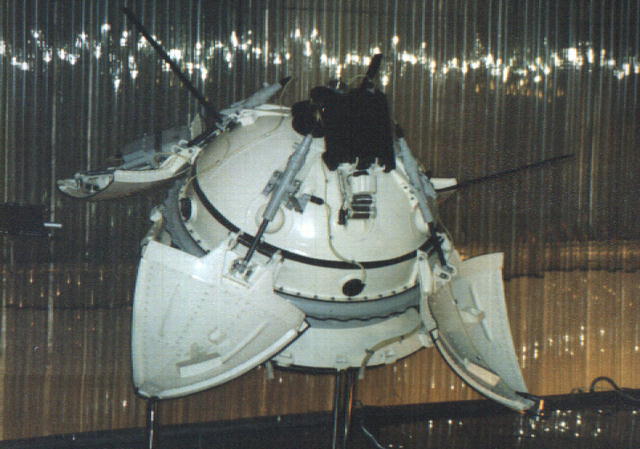
A few of those probes actually made it to Mars, and the Soviet Union had managed to get six landers to Mars before the famous USA Viking mission. They were known as Mars 2-7 (Mars 1 failed during launch). These were actually fairly sophisticated landers for the time, but they involved little more then crashing a probe into the planet and seeing how long it would last. They didn't provide the wealth of information that the highly successful Viking mission did, but they were many properties of Mars that were previous unknown.

Mars 3 Lander model at the Memorial Museum of Cosmonautics in Russia. (Source)

Unfortunately, after this point, the USSR was beginning to run into problems with its space program. They had already been cutting corners, which was beginning to show with the multiple launch failures. But all these failures and the faltering politics brought to an end some of the most ambitious Mars missions on the chalkboard, including sample returns. Since the fall of the Soviet Union, there has been only one failed attempt by Russia to return to Mars, but there are currently plans for a lander on Mars' moon Phobos that will return samples.

So that is a little bit of the early Mars exploration history, with a larger context on Soviet activities. There is a specific reason why to highlight those missions, Mars 2-7. With the exception of 4 and 7, they all made it to the Martian surface. And I also mentioned that the Soviets had been cutting corners. See, they didn't have quite the same idea of procedure we have today. These landers were often poorly decontaminated, if at all. They were likely crawling with microorganism.

Before I have mentioned just how extreme and hardy life can be. This could very well be the case, that some amazing extremophile from our Earth survived a 60 million kilometer trip that lasted months to the surface of Mars. It sounds amazing, it sounds fantastic, it sounds plausible! In the crater of some old Soviet probe in the middle of the cold, dusty Martian desert there could be life from our muddy blue marble, so far from home.

Tardigrade, AKA Water Bear, AKA the baddest animal on Earth, and maybe Mars.

How would our distance brothers be doing? That is a point of contention. The probes could have been entirely sterilized from solar and cosmic activity. Or the microorganisms could still be in a frozen hibernation that they have been in since launch, waiting for the right conditions. Or they might have found just the littlest amount of liquid water nearby and have created a thriving community around the landing site, perhaps even seeping deep into the warmer crust.

If our brothers from Earth have flourished underground, they might have found Martian life not to different from themselves. A recent finding of 'worms' deep in the Earth's crust provides hope for life in similar environments on Mars and other locations. There could be a proverbial 'War of the Worlds' going on between tiny Soviet invaders and native Martians. This is also part of the reason why there is a push for decontamination these days, to not destroy any potential life that might exist or ruin alien environments.

Like I said before, this is conjecture, but it is entirely plausible. And it is testable. If we get to Mars and discover life, it would be fairly simple to determine if the similar to modern Earth-based lifeforms. They would likely carry signatures similar to all other life on Earth, unlike something that developed in a totally isolated Martian environment, which would expect to have a markedly different genetic history.


Monday, May 9, 2011

Life on Ceres

I like to look at my stats and see what people are searching for when they come across my blog. A while ago I got a hit from a search for 'Life on Ceres,' and ever since then I have been considering writing a post about it. So this is for you, person out there looking for information about life on Ceres, and hopefully other readers will enjoy this as well.


I had previously glossed over Ceres in my Asteroids Astro-Lesson. Ceres is the largest object in the asteroid belt, and recently got reclassified to a dwarf planet. It is also the smallest known dwarf planet, Pluto (the former smallest planet) is 14 times more massive. And yet Ceres comprises about 25% of the asteroid belt's mass. Ceres is large enough to shape itself into a sphere, at about 580 miles (930 kilometers) across.

But aside from being a unique and astounding body in the asteroid belt, Ceres may have large amounts of water buried under the crust. Astronomers have suggested this because the ex-asteroid's density is less then that of the Earth's crust, because the surface bears spectral evidence of water-bearing minerals. If 25% of Ceres was composed of water, it would have more than all the fresh water on Earth.

The possible internal structure for Ceres. (NASA)

The majority of the water would be ice, forming a mantle around a rocky inner core, with a dusty crust above. It is currently unknown if liquid water exists on Ceres, but a few astronomers suspect there could be oceans. These oceans could be heated by hydrothermal vents and provide a thriving ecology of basic lifeforms.

The problem with this scenario though, is that it is not clear what would keep the proposed oceans in a liquid state. There is no significant tectonic activity (nor enough mass to sustain a long-term molten core) and no significant tidal friction (like with Europa orbiting Jupiter). Although the idea has some merit for consideration, and provides interesting research. We will have to wait until the Dawn spacecraft arrives in 2015 for any definitive answers.

Now, this is where the idea gets a little fun and funky. Supposing Ceres did have a molten core when it and the rest of the Solar System were young, it could have heated an ocean and produced early lifeforms. Well, we know that early Ceres had an active period of bombardment, where meteorites and smaller asteroids impacted and knocked small chunks off. In fact, there is an entire family of asteroids designated C-type because they share similarities with Ceres and many are thought to originate from there. They also happen to be the most common type of asteroid, carbonaceous asteroids.


What I am getting at here is the idea of panspermia, that life in the Universe can start at one place and be transported to others by meteoroids, asteroids, and comets. Ceres has a low escape velocity, so it is not improbably that any early life forms would be kicked off by an impact. That life could have then been transported to Earth, and we could be the descendants.

This is just conjecture. I should put that as a warning, that there is no solid evidence for this hypothesis, but it exists and it is a tantalizing one to discuss. And it is not wholly impossible, but we really don't know. At least not until we find some body whizzing around the Solar System carrying archaic lifeforms most likely in a dormant state. And even if a lifeform made it to Earth, there's no certainty that it survived, life could have already arisen on Earth and devastated the visitor.

The Earth seems to have perfect conditions for life, and must have had sufficient starting conditions. If life was so well at taking hold here, we could it not be formed here in the first place? Then again, maybe there weren't sufficient conditions to start life. Scientifically speaking, there is no clear definition of what caused life to spark into existence on Earth, and panspermia has been a way to address that. But it still neglects the fact that life would have had to have started somewhere at some point in time.


As we get better at understanding biology and Earth's history, this answer is getting clearer. It is now possible, with the right chemical mixtures that relates to the known early atmosphere of the Earth, to generate complex amino acids and other biological components. I suspect we are really only a few years short of understanding the sparking event that unleashed life on Earth, or at least the origin of life somewhere in the Universe if it was brought to Earth.


Sunday, May 8, 2011

Happy Mother's Day

Seriously, go give her a call, or a hug, or take her out to dinner. Unless you are a mom, then I hope you have a swell day.

On a side note, my presentation when pretty well last night. The youth group seemed to enjoy it, they were mostly in high schools, a couple in middle school. They were pretty smart too, and I always enjoy talking with a smart group of kids, it always leads to an interesting dialogue. And when it comes to alien life, they have some pretty amazing ideas.

But as amazing as some of those ideas are, I have to remind them the importance of science and needing factual evidence. Some of them were even smart enough to talk about shadow biomes: life that may exist on Earth, but we don't recognize as life because it doesn't constitute the classical idea of what is alive. Sure they are a fun idea to think about, but when looking for life in the Universe, it's going to be very hard to find them if we can't identify shadow biomes on the Earth. No, life seems more acclimated to needing water and external energy and the way it thrives here. And looking for Earth-like environments will be be the best indicators of life, mostly because those environments stand out so clearly from the alternatives.

It may also be that the majority of life lives in subsurface oceans of icy bodies. We now know of a number of moons with subsurface oceans, including Europa, Titan, Ganymede, Enceladus. And there probably are more. In fact, tomorrow I am planning to address that idea on the asteroid/dwarf planet Ceres. But these environments would have a hint of Earth-like influence, the would have water and an energy source (usually tidal heating caused by the friction of orbiting a large planet, or internal heat and radioactivity).

Life is an amazing thing to talk about, and I enjoy reflecting on these presentations after I give them. And I thought I'd just share a bit of that internal thought process. Plus, everyone alive owes it to their mother, so that's always relevant and something to be thankful for.

Another thing, I am thinking about entering the world of podcasting! Specifically the 365 Days of Astronomy podcast. Their goal is to provide a different 5-10 minutes podcast everyday from anyone interested in talking about an astronomy related topic. They vary from the professional to the amateur, both in astronomy knowledge and in podcast recording quality. I have listened to a few and they are quite amazing, but they are lacking on volunteers to fill up days. Anyways, anyone is capably of signing up and doing a podcast. There's no commitment to how many I would have to do, but it can't be more often then once a month with them.


Sunday, April 24, 2011

Animals in Space

Since it is Earth Day weekend and Caturday (well it was when I started writing this, then I got seriously distracted), I decided what would a better way to celebrate then to talk about some of the animal we've sent to space.

Human's aren't the only animals from this planet to have gone to space, we have often sent animals to test conditions or for scientific research. Most people know this and tend to think of dogs and chimps, but really the list is a lot more diverse then that. And there are those who proclaim animal cruelty, but it is part of the process for ensuring safe travel in the future. Most of the time these days, animals are put in no real danger, no more then their astronaut counterparts.

So far six national space programs have flown animals to space: the Soviet Union, the United States, France, China, Japan, and Iran.

The first animals sent into space, the first travelers from Earth, were fruit flies. Dramatic, I know... They were accompanied by rye and cotton seeds aboard a U.S. V2 rocket launched on February 29, 1947. The experiment was to test radiation exposure at high altitudes, and the rocket made it past both the US 50 mile and international 100 km definitions of the edge of space. The experiment was a success, the fruit flies were recovered alive and the seeds were able to grow. Future V2 missions would also carried biological samples too. (Source)
What Earth's first emissary to the stars might have looked like. (UW-Madison)

On June 14, 1949, a rhesus monkey named Albert II became the first monkey in space, reaching about 83 miles in his V2 rocket. The first Albert had died due to rocket failure during the missions ascent. Albert II died on impact after a parachute failure. Monkeys would continue to be used throughout the 1950s and 60s, implanted with sensors to measure vital signs and usually under anesthesia.

Albert II's launch. (Smithsonian)

The U.S. launched a mouse into space on August 31, 1950 aboard a V2. Called Albert V, unlike the earlier Albert flights, did not fly a monkey. The rocket disintegrated due to parachute failure. Several other mice would be launched in the 1950s.

The Soviet Union launched the first two dogs into space aboard the R-1 IIIA-1 flight on January 29, 1951. The dogs were Tsygan and Dezik, and although they reached space, they did not orbit. Both dogs survived the flight, but one would later die on a subsequent flight.

The dog Laika would become the first animal to orbit, aboard the second spacecraft to achieve orbit. Sputnik 2 (nicknamed Muttnik in the West) was launched November 3, 1957 with the dog. Laika died a few hours in orbit as planned since there was reentry strategy from orbit developed yet. She was a small stray picked up from the streets. Ten other dogs would reach orbit before Yuri Gagarin's flight on April 12, 1961.

Laika in her flight harness.
Of those other dogs, Belka and Strelka of Sputnik 5, launched August 19 1960, were the first animals to achieve orbit and be returned alive. One of Strelka's pups after the mission was given to Caroline Kennedy as a gift and many descendants are known to exist.

On December 13, 1958, the first squirrel monkey, named Gordo, was put into space aboard a Jupiter IRBM. He was lost to yet another parachute failure, the capsule landed in the Atlantic ocean and was never recovered. Telemetry data from the mission was considered a success though, Gordo survived the stress of launch and weightlessness, alleviating concerns about affects on humans. (Also, you can read about how awesome squirrel monkeys are over at Leaving the Next: An Expat Survival Guide.)

Baker on a model V2 rocket (not his actual spacecraft). (U.S. Army)

Soon after Gordo's flight, a rhesus monkey named Able and a squirrel monkey named Baker would become the first monkeys to survive spaceflight on May 28, 1959. Both survived in good condition. Unfortunately Able died during surgery to remove an infected medical electrode. Baker would live as the U.S. Space and Rocket Center in Huntsville, Alabama until 1984.

Ham the Chimp, hamming it up after his spaceflight. (NASA)

The first chimp in space, Ham the Chimp, launched in a Mercury capsule aboard a Redstone rocket on January 31, 1961. He was trained to pull levers to receive banana pellets and avoid shocks. During the flight this was used to show the ability to perform tasks during spaceflight. About 3 months later, Alan Shepard would become the second human and first American in space. Enos the Chimp would become the first chimp in orbit on November 29, 1961.

France had a relatively short lived animal testing program, running from 1961-67. They first flew a rat (Hector) on February 22, 1961, then two more rats later. Then the first cat, Felix, on October 18, 1963, who was recovered alive. The second cat in space was not. The final launches were of two monkeys in March 1967.

China launched mice and rats in 1964 and 65; two dogs in 1966; and guinea pigs in 1990.

In the 1960s, Argentina launched a series of rats (the first was Belisario, recovered successfully) aboard Orion II rockets. And later two cai monkeys on separate flights, the first using a two-stage Rigel 04 rocket the second using a X-1 Panther rocket. The monkeys never reached the 100 km space mark, and it is unclear if any of the rats did.

Japan launched its first animals, a species of newt, into space on March 18, 1995 aboard the Space Flyer Unit.

Bigelow Aerospace has the distinction of being the only private/commercial launching of animals into space (not counting humans which would include Virgin Galactic). On June 12, 2006, their Genesis I inflatable space module launched with Madagascar hissing cockroaches and Mexican jumping beans (they contain live moth larvae). Genesis II launched on June 28, 2007, with more Madagascar hissing cockroaches and added South African flat rock scorpions and seed-harvester ants.

Tardigrades... IN SPACE!

In September 2007, the European Space Agency's FOTON-M3 mission carried tardigrades, aka water-bears, who were able to survive 10 days exposed to open-space with only their natural protection.

Iran was the latest county to launch animals into space on February 3, 2010. They launched a mouse, two turtles, and some worms on top of the Kavoshgar 3 rocket and returned alive to Earth.

First spider web made in space. (NASA)

Over the years several other animal species have been sent to space, including: macaques, monarch butterfly larva, roundworms, nematodes, many species of ants, crickets, snails, carp, brine shrimp, various insects and insect eggs, spiders, silkworms, sea urchins, various fish species, quail eggs, chicken embryos, bullfrogs, frogs, toads, turtles, tortoises, meal worms, flies, and parasitic wasps.

All of these missions have gone on to help understand the effects of life in space. Our earthly compatriots join us on our journey to the stars and are important to understand because we will likely need them when we leave Earth. The study of the effects of living in space is a part of astrobiology.

Who knows what we will send next? Any of you guys have any suggestions? I know I would personally like to see bird in space (that isn't an egg/embryo), but would be tough to do with their fragile bone structure.


Friday, April 22, 2011

Fantastic Planet

So you may have noticed I didn't write anything yesterday. I just wasn't feeling it. When I write, I want it to feel like something I want to do, to have if flow from me. I believe it should be an enjoyable experience. And yesterday it just wasn't on, so I didn't post. In the mean time, I've been thinking of some future posts I might want to make. Getting an idea for future content has been pretty important for this blog so far, as you might tell from a lot of my posts, I tend to do my homework.

Anyways, today is Earth Day! Hurray for the Earth! If you haven't figured it out after spending your entire life here, the Earth is a pretty awesome place. It's got liquid water, oxygen, an atmosphere, complex carbons, and various forms of protection including the ozone layer and magnetosphere. All of these make Earth a pretty comfortable place for life! In fact it is the only place in the whole Universe where we know for a fact life exists! And it is some pretty amazing and complex life all on its own.


The Earth is a fantastic planet and we should all be so lucky to owe our existence to it's being in the right place with the right stuff. So please take care of your Earth, where ever human's may go in the Universe, it will always be home.

-------------------------------------------------------------------------------------------------------

This next part is dedicated to my friend Leroy. I've known him for years and he is a bit of a musician and a street performer. If you've ever been to D.C. you might have seen him too, he tends to dress in a folky style and plays his guitar just about everywhere. You can check out a couple of his tracks on SoundCloud.

I made a promise to Leroy to watch the movie Fantastic Planet and write about it, now this was a good month and half to two months ago. I've been putting it off a bit, but the version he wanted me to watch is on Google videos and re-scored in 2003 with industrial/experimental music like Aphex Twin. Anyways, with Google videos being shut down on April 29, he reminded me to watch it before it got taken off.


If you haven't heard of Fantastic Planet before, it is a French animated science fiction film from 1973, and is a bit trippy. The French name is La Planète Sauvage, or The Savage Planet. It follows the story of a human named Terr on the planet of the Traags. The Traags are a hundred times larger then humans, and blue, and well, look like the thing in the picture above. Humans are also known as "Oms," a play on the French word for men, hommes. Now, I may spoil some of the story for you, but I don't expect many of you to actually go watch the movie.

The Traags apparently picked up the Oms from Terra (Earth) after some sort of apocalyptic event, images show destroyed structures and technology. Being that this movie was made during the Cold War, it is a good bet this was an influence on this imagery. Oms seemed to have originally been gathered for labor, but quickly grew into being domesticated pets for some, while wild ones were seen as pests. In fact, the treatment of Oms seemed to contrast with their high level of technology and spiritual development.

The planet of the Traags is pretty funky. The lifeforms there are all the kind of trippy things you would expect on an alien planet. A week on the planet roughly equates to a human year, and one of their 3 seasons is about 15 human years. The Traags also spend a large amount of meditating. In the end the meditating turns out to sort of 'astral project' themselves on to their moon, called the Amazing Planet, were the meet with other meditating travelers from across the galaxy and dance, which some how allows them to breed.

While the Oms seem like pests, its mostly because, well, most people I know can actually be pests, ha. But they end up living a rat like existence in abandoned parks, stealing food from Traag homes, and generally unintelligent. Until Terr comes along with a knowledge headphone that he stole from his former master. The Oms are seen to breed much faster then the Traags too, the Traags tend to 'de-om' every 3 cycles (?) which is more then enough for a whole Om generation to grow. After the Oms kill a Traag who tries to crush them with his feet, the Traags go over time, de-oming twice a cycle with new technology.

Terr and the other Oms hide out in an abandoned rocket dump, where they learn from Traag technology and build their own rockets, in the hope of escaping to the Amazing Planet. They escape in the nick of time and discover the Traag's secret of the moon and start blasting their vulnerable astral projections with lasers. This threatens to destroy Traag society, so the leader of the Traags offers to make peace and stop killing the Oms. An artificial satellite is made about the Fantastic Planet, named Terr.

Typically, this kind of trippy movie isn't my sort of thing. The animation was a bit humorous though, some of it reminded me of that Monty Python style. The soundtrack was pretty excellent though, I guess that has to do more with it being re-scored with more modern music. The story was a pretty good one too, a fairly solid science fiction story, and I am one who enjoys some science fiction.

That wraps up my little review of this movie. You can watch the film here for yourself before it gets taken down on April 29. And don't forget to keep voting for this Tuesday's Astro-Lesson in the sidebar! Happy Earth Day, and for those who celebrate it, have a good Good Friday and Hoppy Easter.


Sunday, April 17, 2011

Extremophile Pt. 2 (Life in the Extreme)

Welcome to part two of the extremophile post, Life in the Extreme. Last time we covered all sorts of weird forms of life that lived in extreme environments, from deep below the ocean, to volcanoes, to sulfur caves, to the Antarctica, and I made fun of my cat. Today, more of the same, with some of the most extreme extremophiles yet, record-setting and award-winning even. These things push the boundaries for what is accepted as the "habitable zone". So, lets get to it!


Saturday, April 16, 2011

Extremo-Caturday (Extremophile Pt. 1)

So we figured out what was wrong with our internet. Our router died, it would turn on, lights blink for like a minute and then die. So we had to go get a new router. And now I am back to blogging.

It is yet another Caturday, so what better time to go through some of the crazy lifeforms that exist on Earth. These extreme lifeforms are known as extremophiles, because they thrive in places that we may consider adverse conditions for life. They live in places that are extremely hot, cold, acidic, salty, radioactive, dark, dry, or have high pressures.

Astrobiologists like to study these organisms because most places in the Universe seem to be adverse to life, and if these little critters can make it, then it gives hope that life may actually be abundant. It also lends support to the Rare Earth Hypothesis, where higher animals with intelligence are an extremely rare form of life but simple life is abundant.

So here are some of the stars extremophiles (most information comes from NASA's Night Sky Network):


Saturday, March 26, 2011

Birdoday

Wait. What?

Yeah, I haven't done a Caturday post in the past two weeks. Not that it matters, my cats have been boring, lazy, cute fluffballs. Nothing to add there.

I'd actually rather show you this funny video. See, I was watching the Science Channel the other night and saw a special on New Zealand and how its 'birdland.' or at least was, before explorers brought rodents. These parrots, Kakapo (meaning Night Parrot in Maori), were featured prominently. This isn't the video I saw, but its sufficiently cute/awesome.


Anyways, these cute, flightless, fat parrots reminded my of my fat cat, Reyn. They are pretty cute, but they are endangered. Humans have considered them a delicacy or easy roadside food, and rodent enjoy their eggs. There are, as of February 2010, 120 known living individuals, making them the rarest parrot in the world. I don't know how they are doing over a year later, but there is definitely a plan for recovery. Wikipedia is, of course, where I send my reference.

They also have cousins, the Kea, the only true alpine parrot in the world. They are confined to the Southern Alps, the mountain range that runs along New Zealand.

As a minor astrobiologist, I have a love for all life forms. It is sad to see a unique ecology threatened.  Every extinction is a loss to the over all study of life. There is a small advantage in knowing what dominates on Earth, but it divides us from alien possibilities. There is a special knowledge now that says birds are directly related to dinosaurs. And understanding flightless birds in New Zealand gives us an amazing chance to look back in time.