Showing posts with label Jupiter. Show all posts

Wednesday, August 3, 2011

On Hold

I'm putting this blog on the back burner as I need to focus on getting my life organized. I'll hopefully be back whenever I find a stable form of income. It may not be daily when I get back, but I would like to try to update every other day, there's still so much to write about, literally a whole Universe.

I do enjoy it though, sharing a bit of the Universe with readers. I already do astronomy outreach in my community, and I always felt this was a nice way to reach a larger audience. But, there's only so much someone can do without gainful compensation. I would hope that even if I don't come back, I would hope that my readers continue following our expanding understanding of the cosmos. A good list of informative sites are in the sidebar to the right, under 'Useful Astronomy Links'.

I do plan to come back to this though, maybe in a month or so. Maybe I will be refreshed and holding a legitimate job and ready to blog again. Until then, there's still lots out there to be amazed at. Today I was blown away by the rather legitimate idea that the Earth might have had two moons at one point. Then there have been other stories: LEGO figurines on the NASA spacecraft Juno, which is launching for Jupiter on Friday; Oxygen particles detected in deep space; The ESO has discovered 96 new open star clusters in the Milky Way that were hidden by dust; and my favorite asteroid, Vesta, is being revealed in amazing detail, and a short video of its rotation.

I suggest spending this weekend looking to see if you have a local Vesta Fiesta (my astronomy club is hosting one during our normal open house.) And if not, you should definitely go out and look for shooting stars, the Delta Aquariids and Perseids meteor showers are overlapping this weekend. Since the height of the Perseids will have a full moon, this weekend might be a great chance to go out and take a look.

I'll see you all when I get back.


Monday, June 20, 2011

So Much Science, So Little Time

I hope everyone enjoyed their Father's Day weekend, I know I had some good times with my family. There has been some great astronomy stuff happening (as always) so I figured I'll dump some links.

This hemispheric view of Venus was created using more than a decade of radar investigations culminating in the 1990-1994 Magellan mission, and is centered on the planet's North Pole. This composite image was processed to improve contrast and to emphasize small features, and was color-coded to represent elevation. Image Credit: NASA/JPL/USGS

First up, Life's Little Mysteries is presenting The Greatest Mysteries of the Cosmos every Friday this summer. They are starting with our solar systems and first was The Greatest Mysteries of Venus. It is a great opener to understanding out planetary evil twin.

Dawn captured this view of Vesta on June 14, 2011. Credit: NASA / JPL-Caltech / UCLA / MPS / DLR / IDA

NASA's Dawn spacecraft is getting closer and closer to asteroid Vesta by the day. It now has a better resolution than the Hubble Space Telescope. The image above was taken on June 14, 2011 from a distance of about 265,000 kilometers. Each pixel spans roughly 25 kilometers. As The Planetary Society explains it:
There's clearly a deep crater in the northern part of the image. And the outline is definitely lumpier than the outlines of similarly sized bodies in the outer solar system (like Mimas and Enceladus), but we knew that already; the rock that Vesta is made of is able to hold up steeper mountains than the relatively low-strength ices that outer planet moons are made of. Apart from that, it's still hard to tell what's albedo differences and what's topography. But that won't be true for long.


In the skies of Mars, there was recently an amazing alignment. On June 1, Mars' tiny moon Phobos slipped in front of Jupiter from the view point of the ESA’s Mars Express orbiter. Above is an animation of the event, using photos taken with the Mars Express’ High Resolution Stereo Camera (HRSC). In addition to being a cool event, the observation also helps to improve knowledge of the martian moon's orbital position.

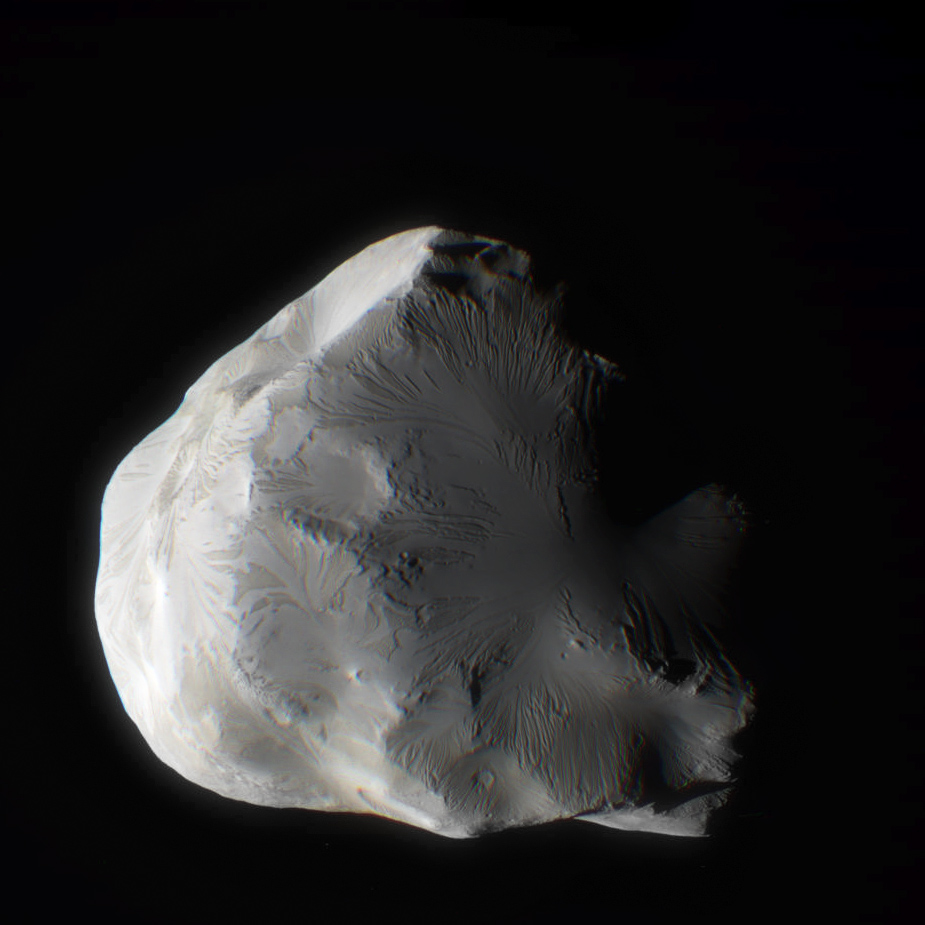
Color composite of Helene from June 18, 2011 flyby. There’s a bit of a blur because the moon shifted position in the frames slightly between images. NASA / JPL / SSI / J. Major

And speaking of tiny moons, the Cassini spacecraft out at Saturn performed a flyby of Helene on June 18. The second-closest flyby of the icy little moon helped to map the surface and better understand the history and gully-like features seen on previous flybys. You can read more about it here.

In other news, the Space Shuttle Atlantis had its final payload delivered on Saturday, June 18. The shuttle is on track for the final flight, STS-135, on July 8. The main payload is the Italian- built “Raffaello” logistics module for the International Space Station, which contains 5 tons of "critical space parts, crew supplies and experiments to sustain space station operations once the shuttles are retired". The secondary payload is dubbed the Robotic Refueling Mission (RRM) – a sort of “gas station in space”.

And finally, tomorrow, June 21, is the longest day of the year for the northern hemisphere, the summer solstice. Hopefully everyone enjoys their long and warm day. Though consequently, it is the shortest day in the southern hemisphere, so keep warm guys.


Tuesday, June 7, 2011

Our Changing Solar System

As they keep searching, astronomers learn more and more about how our Solar System formed. There is a good amount of understanding on how things happened, but a lot of the finer details of just why things appear the way they do still have to be answered.

Our Solar System is like a giant cosmic puzzle, and we are constantly finding new clues about the course of its evolution.

This week a few amazing findings that are redefining the way we understand our Solar System, planet formation, and what we might expect to find in other star systems.

An artistic rendition of the impact that created the Moon.

The idea that our Earth-Moon configuration is a rare occurrence has been challenged by simulations. Our Moon is considered to be disproportionally large, at over a quarter of the Earth's diameter. The Moon was formed from a large impact between a young Earth and a Mars-sized planet. The simulations run by researchers from the University of Zurich's Institute of Theoretical Physics in Switzerland and the Laboratory for Atmospheric and Space Physics at the University of Colorado show that these kinds of impacts might actually be much more common, perhaps as many as one in 10 rocky planets around a Sun-like star may host a large moon.

What is even better about this news, it is a way to help identify possible habitable planets. The Moon plays a large role in making the Earth a livable place between blocking would-be impactors and stirring the tides. Other planets with large moons could be ripe for life.

In this artist's conception, gas and dust—the raw materials for making planets—swirl around a young star. The planets in our solar system formed from a similar disk of gas and dust captured by our Sun. Credit: NASA/JPL-Caltech

The planet-sized object that glanced the Earth might have gotten its gravitational push from Jupiter. In another piece of news, researchers from around the world and NASA have developed a new model about the early motions of planets in our Solar System. The biggest news in this is the roaming of Jupiter, at one point it would have wandered almost as close to the Sun as Mars (before Mars was there), it would have only been stopped by the counter pull of Saturn.

The effects of Jupiter's motions have a profound impact. Over millions of years, Jupiter would have pushed around objects in our neighborhood. The nature of the asteroid belt would owe itself to these gravitational interactions. And probably the biggest impact is that Jupiter prevented Mars from growing to a larger planet. Jupiter either absorbed or scattered most of the material in the region Mars exists in, leaving slim pickings for planet formation.

A previous concept about the edge of our Solar System, which may be changing with new findings. Credit: NASA

And the last story about our amazing Solar System doesn't quite flow with the other two as well, but is still important. NASA is holding a teleconference on June 9 to discuss conditions at the edge of the Solar System. Based on data from the Voyager probes, the view of the edge of our Solar System needs to be changed.

The discussion will be about "a new computer model that shows the edge of our solar system is not smooth, but filled with a turbulent sea of magnetic bubbles." Since this is a poorly understood and previously unexplored region, there is much to be learned. Understanding is important though, this is a region that protects us from galactic cosmic rays.

Another reason why I am interested in this particular conference is because one of the panelists I have met before. Merav Opher used to be an assistant professor at my alma mater, George Mason University. She is wonderfully intelligent and I have found her work with the Voyager probes absolutely fascinating.


Wednesday, March 2, 2011

March 2011 Highlights

March is one of my favorite months, there is spring break, St. Patrick's day, the beginning of spring, and lots of birthdays (mine included). It also is when things start to warm up and more people can tolerate being outdoors at night, a when more people start coming outside to do observing. It isn't as nice as a warm summer's eve, but its getting there. Although if you are in the southern hemisphere the opposite is probably true. Anyways, I wanted to start a new monthly segment that covers some of the astronomical highlights of the coming month. This includes Saturn brightening every night as it nears opposition (closest to the Earth) in early April, and Venus bright in the dawn sky for the whole month.

So here's what else you can look forward to: