Showing posts with label Saturn. Show all posts

Monday, June 20, 2011

So Much Science, So Little Time

I hope everyone enjoyed their Father's Day weekend, I know I had some good times with my family. There has been some great astronomy stuff happening (as always) so I figured I'll dump some links.

This hemispheric view of Venus was created using more than a decade of radar investigations culminating in the 1990-1994 Magellan mission, and is centered on the planet's North Pole. This composite image was processed to improve contrast and to emphasize small features, and was color-coded to represent elevation. Image Credit: NASA/JPL/USGS

First up, Life's Little Mysteries is presenting The Greatest Mysteries of the Cosmos every Friday this summer. They are starting with our solar systems and first was The Greatest Mysteries of Venus. It is a great opener to understanding out planetary evil twin.

Dawn captured this view of Vesta on June 14, 2011. Credit: NASA / JPL-Caltech / UCLA / MPS / DLR / IDA

NASA's Dawn spacecraft is getting closer and closer to asteroid Vesta by the day. It now has a better resolution than the Hubble Space Telescope. The image above was taken on June 14, 2011 from a distance of about 265,000 kilometers. Each pixel spans roughly 25 kilometers. As The Planetary Society explains it:
There's clearly a deep crater in the northern part of the image. And the outline is definitely lumpier than the outlines of similarly sized bodies in the outer solar system (like Mimas and Enceladus), but we knew that already; the rock that Vesta is made of is able to hold up steeper mountains than the relatively low-strength ices that outer planet moons are made of. Apart from that, it's still hard to tell what's albedo differences and what's topography. But that won't be true for long.


In the skies of Mars, there was recently an amazing alignment. On June 1, Mars' tiny moon Phobos slipped in front of Jupiter from the view point of the ESA’s Mars Express orbiter. Above is an animation of the event, using photos taken with the Mars Express’ High Resolution Stereo Camera (HRSC). In addition to being a cool event, the observation also helps to improve knowledge of the martian moon's orbital position.

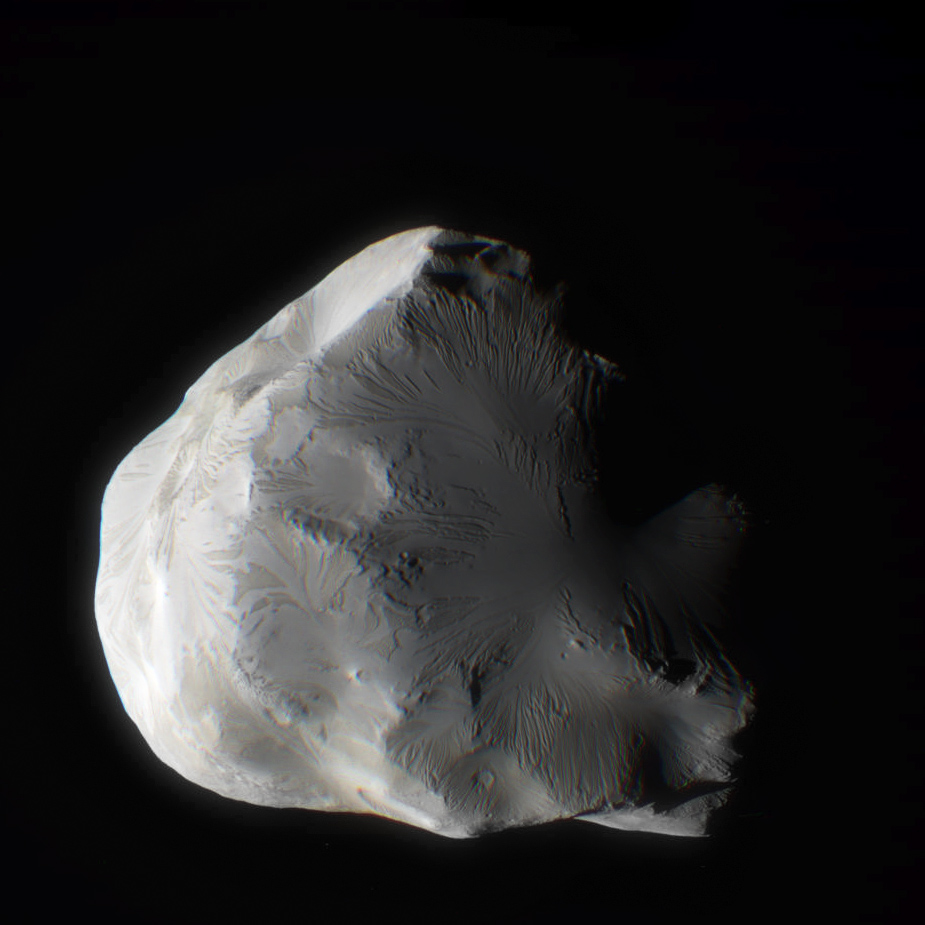
Color composite of Helene from June 18, 2011 flyby. There’s a bit of a blur because the moon shifted position in the frames slightly between images. NASA / JPL / SSI / J. Major

And speaking of tiny moons, the Cassini spacecraft out at Saturn performed a flyby of Helene on June 18. The second-closest flyby of the icy little moon helped to map the surface and better understand the history and gully-like features seen on previous flybys. You can read more about it here.

In other news, the Space Shuttle Atlantis had its final payload delivered on Saturday, June 18. The shuttle is on track for the final flight, STS-135, on July 8. The main payload is the Italian- built “Raffaello” logistics module for the International Space Station, which contains 5 tons of "critical space parts, crew supplies and experiments to sustain space station operations once the shuttles are retired". The secondary payload is dubbed the Robotic Refueling Mission (RRM) – a sort of “gas station in space”.

And finally, tomorrow, June 21, is the longest day of the year for the northern hemisphere, the summer solstice. Hopefully everyone enjoys their long and warm day. Though consequently, it is the shortest day in the southern hemisphere, so keep warm guys.


Friday, June 3, 2011

The Cassini Mission: The Movie


CASSINI MISSION from cabbas on Vimeo.

[You'll probably want to watch this with HD and full screen turned on.]

This is footage from the Cassini Imaging Science System by the hard workers at NASA. The Cassini spacecraft has been orbiting Saturn for nearly 7 years now, tracking moons, rings, and the planet. Many thousands of images have been sent back to Earth and have been enjoyed by the public over the past few years.

Videographer Chris Abbas got the idea to string them together into a video. The result was an eerily beautiful look at the sixth planet using raw, unprocessed data. You can see some of the 'defects' that astronomers tend to work around since it gets in the way of the science being done. But in the case of art, the dark donuts created by dust in the camera, cosmic rays hitting the detector, and imperfections in the camera itself; they all add to the beauty of things.

Abbas included a quote of Carl Sagan with the video, a quote that inspiring with this video:
"Somewhere, something incredible is waiting to be known."
(If you have problems getting the embedded Vimeo video to play, you can watch the video here.) 


Saturday, May 28, 2011

Space News With Lots of Pictures.

Lots of astronomy stories have been published in the past week, and I've been rather busy trying to keep track of them all. The best things about these stories, and about astronomy in general, are the pictures. They can tell so much and most of them look beautiful. So, I've rounded up a bunch of the amazing pictures published in the past week or so, and will probably give a short paragraph about them:


Lets start with the star that changed the Universe. The Hubble telescope viewed this variable star that actually resides in another galaxy, our neighbor, Andromeda. Before this star was discovered, the fuzzy patches of galaxies were just called nebula, and thought to be just gas inside our own galaxy. Edwin Hubble (the Hubble telescopes namesake) changed all that in 1923, discovering that these nebula were indeed other galaxies, and used this variable star to determine that they were millions of light years away. You can read the historic story here.

Image Credit: NASA/JPL/Space Science Institute
NASA released these amazing raw images taken by Cassini of Saturn's moons Titan and Enceladus. These images, haven't been processed or colorized yet, but absolutely blow my mind. A couple of the highlights can be seen here, while the full set is over here.

Image Credit: Gemini Observatory/AURA/Andrew Levan

Probably the most distant object ever seen, for now. This is a gamma ray burst, known as GRB 090429B. I made a post about GRBs awhile ago. If you want to know more about the science behind how this sort of stuff is determined, Bad Astronomy has got you covered. And here is the original story with a link to the paper.


WISE, the Wide-field Infrared Survey Explorer, was turned off awhile ago, but the work still goes on. NASA released a gallery of nine spiral galaxy images taken by WISE. For more info on each galaxy, check out the NASA release. (There is also a really huge version of the image, which is drool inducing.)

Docked Endeavour at ISS through a fish-eye lens. Image Credit: NASA

Photos from the last space shuttle spacewalk, it also marked the formal completion of the U.S. segment of the International Space Station. You can go through the entire photo set here.

Image credit: NASA/JPL-Caltech/University of Toledo
This graphic illustrates a stellar fountain of crystal rain, beginning with a Spitzer picture of the star in question, and ending with an artist's concept of what the crystal "rain" might look like. The full article is here.

Of course, there are a couple of stories out there that just really don't have good pictures to go with them. A few of them I suggest checking out are: New arm discovered in outer edge of the Milky Way Galaxy; The Moon is wetter then we thought; For Mars, rapid formation stunted growth; and Info on OSIRIS-REx, NASAs new science mission to asteroid launching in 2016. Have a good Memorial Day weekend to everyone in the U.S. Everyone else, just have a good weekend.


Friday, May 13, 2011

Blogger Annoyance & Moon Photos

So, as a few of your may have noticed blogger has been an annoyance, being down most of the past two days. I can understand that, updates need to be done, but something seems to have gone terribly wrong with the entire thing.


As it stands now, I lost my Endeavour Launch Update article, I hope that it may be returned... If not, know that Space Shuttle Endeavour is set to have it's final launch at 8:56 a.m. EDT on Monday, May 16. Everything is on course and repairs to the Shuttle's heater system that caused the initial delay have been fixed. After this flight it will go into retirement and be displayed at the California Science Center.

The launch of the Space Shuttle Atlantis has been pushed back to mid-July.

The argument can be made of why retire the shuttles and so forth. Their need for retirement is made obvious by this delay and the previous delays and the all but certain delay of Atlantis. These shuttles are falling apart, they are old, they need replacement. This process was started under the Bush administration, but even in the Clinton administration doubts were beginning to be raised.

As for why there isn't a replacement on hand, it is an unfortunate bureaucratic side effect. There was a plan, the Constellation program that was to design and build new Ares rockets and the Orion space capsule (akin to the Apollo capsule, but larger and more up to date). The program was severely over budget and bogged down by bureaucratic red tape and political pressure. One of the first things the Obama administration pushed was a complete overhaul which rightly cancelled the Constellation program. But rather than throw the baby out with the bath water, the Orion capsule is still being developed and the work on the Ares rockets is being used in further rocket developments. All in all, it's sad that things got off track, but we are hopefully on the right track right now.


So with that cleared up, I have been busy with blogger being down. First, I have been elected to the Board of Directors for the Harford Country Astronomical Society. After only a short year of being with them I have thoroughly enjoyed my experience with them, as I am sure they appreciate my help. Now I get to have some input on the direction of the club as far as outreach events and observing and astrophotography. I am pretty excited and hope to do good for the club, even though every organization has its internal issues and debates.


Next, earlier this week I finally got the piece for my telescope that allowed my camera to be in a position so that it would take focused shots. You may remember about a month ago, I published my first set of (blurry) pictures along with a video of the Moon. Well, I got a new video (below) and a new moon shot(above), as well as a shot of Saturn. Thinks look a lot better being able to focus correctly. Plus I figured some things out with Windows Live Movie Maker that made the video better.


I still have some things to learn. The moon is a fairly easy target, but Saturn was tricky. My telescope doesn't track to well either. I pretty much had to take a video of Saturn and pluck out the best frame for the image I have below. I also need to find the right camera settings for taking images of planets, as it was hard to just get Saturn to resolve an image. (The blue has is from atmosphere, it was slightly cloudy.)


I think that about wraps things up. I am hoping to get better and this and share more of my own images with you in future. The HCAS observatory is off limits due to construction of the next few months, so I probably won't have much in the way of deep sky objects to share, so hopefully this will do.

With my schedule out of whack from Blogger issues, I am trying to consider what I am going to be doing over the next week. Monday will most definitely be devoted to the hopeful shuttle launch, Tuesday another Astro-Lesson, and Wednesday or Thursday will hopefully see my 100th blog post!


Friday, April 1, 2011

April 2011 Highlights

We are firmly into spring, even though it doesn't look much like it here, cold and wet still. But, in the northern hemisphere, April brings the promise of warmer weather! There is still the problem of 'April showers,' which can hassle astronomical observations, but hopefully the weather won't interrupt to many events this month. April has been designated Global Astronomy Month by the Astronomers Without Borders, so your local astronomy club might be up to something fun.

This month will see Venus continuing to be bright in the morning sky; and Saturn will rise shortly after sunset, reaching opposition (closest approach to Earth) early in the month, it will be bright. I try to keep this to planets and stuff that you can visually see, so no need for a telescope. Unfortunately, most of the planets are early morning this month. So unless you are an early riser, or really late sleeper, you'll probably miss out.

Here is more you can look forward to:


Wednesday, March 23, 2011

A Dusty Blog Post

Dust, it's everywhere! From the Earth-based perspective, dust is that layer of film made up of dirt, mostly biological, that settles on things in the corners of your room, or floating in the air reflecting light. On a cosmological scale, dust is made up of a huge variety of materials, literally just about everything in the Universe. And once cosmic dust settles, it forms stars and galaxies.


Cosmic dust also has a pretty large range in size, from just a few molecules up to a couple microns (µm). There really is no upper limit, but after a certain point, things obviously start to become asteroids and comets and meteoroids and such. There is a proposed definition for a meteoroid of being between 100 µm and 10 m across. That would then classify dust any smaller then 100 µm, and starting on a molecular level. Human hair is usually around 100 µm thick.

Cosmic dust can further be distinguished by it's location.


Sunday, February 13, 2011

Saturn & Storm

Credit: HCAS Members
So there he is (Saturn is a male god). Click to enlarge for a little bit more detail. It isn't the highest quality, especially given the conditions. And I don't have the exact specs on the number of exposures and length of exposure. What I can tell is that we used the observatory's 14-inch Celestron C-14 Schmidt-Cassegrain (the telescope). The mount is an Astro-Physics 1200 GOTO computerized system. The camera used was the Orion Planetary Imager and Autoguider. And it was a lot of fun to stay out there until 2 in the morning hangout and messing with settings and such.

The reason why the picture isn't something you might see in a magazine or from NASA is because we are not NASA or highly funded. But given what we do have, this is a great photo. I do believe I linked to the Cassini image of the storm on Saturn a couple post ago. Here it is again, in case you don't feel like scrolling around looking (I don't blame you). A couple of other issues we had to deal with were a high seeing (the amount of disruption by the atmosphere) and Saturn is still pretty far away. Saturn is about two months from opposition (A.K.A. when it is closest to Earth), so this was about as large as could blow it up without distorting the image.

OK, I got some of the more technical details out of the way, now for the fun stuff. Saturn looks its usual pretty self, fitting for Valentine's Day. There is some good detail in the rings, if you look at the top and bottom of the rings, you can see a black split between them. This is the Cassini Division, a gap between the A and B rings, you can read more on Wiki about it and it's discoverer.

I also keep mentioning this storm, and it may not necessarily be obvious what it is looking at that image. The storm is the white streak near the north pole of Saturn. There is a dark band just below it, and the darker polar cap above it. Unlike storms on earth and some other planets, storms on Saturn tend to streak. This is because Saturn has really strong winds that can reach 1,800 km/h. It also has a radius about 9 times larger then the Earth's but it's day is only 10 and half hours long. So you have this huge thing rotating around really fast. Storms tend to bloom up from the lower atmosphere and when they hit the upper atmosphere they start creating the streaking seen in this image.

All in all, I think it is a beautiful and amazing process. Something lovely to see on Valentine's Day. Unfortunately none of the moon's showed up in the image, I know when we were looking at Saturn through the scope's eyepiece, we could see 5 or 6 of them. The great part about this is also that this is a tease for April, when Saturn is at opposition. Then we will be closer, hopefully Saturn will be higher in the sky and we will have less atmospheric issues (it started clouding up for us around 1 AM and was totally overcast by 2 AM) ending up with an over all better and brighter picture, and hopefully a couple moons.


Not The Ring I Was Expecting to Post

I was hoping to have an image from last night's observing session of Saturn ready for posting, and have a write up to go along with it. Larry (the guy from the club who does most of the image processing) is still working on it, but it sounds like our goal was at least partially achieved, the processing has just been difficult. Hopefully I'll have an image tonight or tomorrow, and then can share that.

In addition to that, The HCAS open house last night went pretty well. We a couple of scout troops that came out, and they seemed really enthusiastic and everyone had a good time despite the cold weather. I know I always enjoy it when the kids are enthusiastic and have more questions to ask.

And in lieu of not having Saturn, with its beautiful rings and chaotic storm, I bring you another story of a beautiful ring and chaos. The Chandra X-Ray Observatory (one of NASA's wonderful satellites and the flagship for X-ray astronomy) has captured an image of a giant ring of black holes.

Credit: X-ray: NASA/CXC/MIT/S.Rappaport et al, Optical: NASA/STScI 

Above is a composite image of Arp 147, a pair of galaxies that collided. It is a composite of optical data from the Hubble Space Telescope and X-ray data from Chandra (the pink blobs). On the right are the remains of a spiral galaxy that collided with the elliptical galaxy on the left. When they collided, a whole bunch of dust would have been compressed, starting a wave of star formation throughout the spiral galaxy, creating massive young stars, seen as the blue ring in the image. These stars have relatively short life spans of a few million years, eventually blowing up into supernovas that leave behind neutron stars and blacks holes.

In the blue ring, you can see the nine pink blobs. Those are X-ray sources observed by Chandra that are so bright, they must be black holes, each about ten to twenty times more massive then our Sun. All in all, it is a beautiful sight, and an amazing formation to discover in our universe. Other elements in the picture include a foreground star in the lower left, and a quasar up and to the left of the elliptical galaxy. There is more info in the Chandra press release linked above.


Saturday, February 12, 2011

Saturn-day!

I am pretty excited about observing Saturn tonight. Hopefully in the next couple of days I'll have a picture to post from the club, perhaps even some video. And the weather looks to be good, it will be mostly clear, with some clouds around 1 AM. And a relatively warm 30 degrees.

What the goal tonight is, is to resolve this massive storm on Saturn. That link shows probably what Saturn will look through the observatory's C14. The storm is that massive white smear on the northern hemisphere. It is several times larger then the Earth, and you thought you were having bad weather this winter. Here is an older close up taken by Cassini, taken on Christmas Eve, just when the storm was first starting out.

An the more literal side, Saturday really is named after Saturn! Father of Jupiter, Neptune, and a bunch of other celestial bodies. God something... and leader of the Titans, which is fitting, with the majestic rings, and 62 moons, traditionally named after other Titans.

In related news, Saturn-day is Caturday! Here's a picture of our cat Reyn:


Thursday, February 10, 2011

The Other Side

The last time I had gone into why I chose the 'Habitable Zones' part of the name for my blog. The connection to astronomy and astrobiology, two topics I am really enthusiastic about. Today, I am going to delve into the other side, 'the Internet.' And maybe try to build some obscure connection between them. There doesn't seem like much other then a cool sounding name.

Obviously this blog is on the internet, and so are all blogs, that is the nature of a blog. They are all mostly run by people. And even those that might be bots had to be set up by someone, and sometimes people run multiple blogs. And outside of blogging you have social networks, news sites, news aggregators, message boards, search engines, personal websites, game websites, picture websites, and the list goes on. On top of that you have video games, e-mail, and instant messengers that use the internet The internet is fully and totally inhabited. It has been built, run, and grown by people. It really is a great social undertaking, and there really isn't that much anti-social about it despite what some critics may say. It has probably risen to the greatest social tool in the history of human civilization.

But it isn't just a social tool, it is a research and development tool, a problem solving tool, an information tool. Despite its social qualities, the internet is still used to research large populations of people, such as what Google does. There aren't really very many free things on the internet*, usually when individuals get something for free, its not because they are the target consumer, it is because they are the product. To Google and Facebook, and probably even Blogger, I as an individual am a product, but that's not necessarily a bad thing.

The result is that we have created an interesting ecosystem on the internet. It is full of big players, individuals, and the curiosities we create. This includes all the viruses, worms, and trojans that all act on their own. The hackers, crackers, and leakers with their individual agendas. And you. All part of this infosphere, a growing augmentation to the limits of our own Earth, a repository of information. A sign of our intelligence and a culmination of life inhabiting our planet. It is something that, barring utter catastrophe, will grow with human evolution. I am willing to say that any other life out there would have an infosphere just like we do.

And that's where I'm leaving off for tonight, there leaves much to be said, but it will all come in the future. Next time I am considering a few things. Maybe gadgets, maybe astronomy, who knows. I am pretty excited for Saturday night though. I am going out with the Harford County Astronomical Society (HCAS) for their monthly open house and then after that we are going to observe Saturn and its current mega storm. We will attempt photos and maybe some video, if the weather holds out for us.

*There are many amazing open source projects on the internet, and probably the best free product is Linux.