Showing posts with label Solstice. Show all posts

Tuesday, June 21, 2011

Astro-Lesson: Summer Solstice

The Sun as it appeared just a few minutes before today's solstice occurred. (Credit: NASA/SDO)

As of 17:16 UTC (1:16 p.m. Eastern US time) today, June 21, 2001, the Sun will reach the furthest north of its travel across the sky. This event is known as the summer solstice in the north, and consequently has the most daylight of the year. In the southern hemisphere, it would be the winter solstice and the shortest day.

The summer solstice is generally used to either mark the beginning of summer or the midpoint, neither is really right or wrong. Seasons are kind of an abstract notion as it is. But from this point on, the remaining days of the year will get slightly shorter until we reach the winter solstice on December 22.  But, that doesn't necessarily mean cooler days, as anyone who has experienced the month of August knows. (And again, for all of those in the southern hemisphere, just the opposite is true.)

Solstice and Equinox. (Credit: NASA)

What causes this change in seasons has everything to do with the tilt of the Earth. The distance of the Earth from the Sun has nothing to do with it, though I know many people who have been incorrectly taught so or envision it this way because the Earth's orbit is slightly oval. In fact, for the northern hemisphere, summer occurs when the Earth is furthest away from the Sun. And if distance were the cause, then both hemispheres would have the seasons at the same time.

What really happens is that the Earth appears to "wobble" around the Sun on its tilted axis. And because one hemisphere is pointed tilted more towards the Sun due to this wobble, it gets more direct sunlight and longer days. This happens until the Sun reaches a certain number of degrees (currently 23° 26′ 16″) north or south of the equator, and then the Sun appears to travel back across the sky to the next point. These lines at north and south are known as the Tropic of Cancer and Tropic of Capricorn, respectfully. And tracing the Sun's path between these two points, every day at the same time, leads to the formation of a figure-8 pattern called an analemma.
Solar Analemma over Athens, Greece. The lowest point is on the winter solstice, the highest is the summer, the crossings are the spring and fall equinoxes. (Source)

Anyways, I hope you have enjoyed the longest day of the year hear in the northern hemisphere. It tends to be a well celebrated day all around the world, and has been since ancient times. Sites like Stonehenge and the ruins of ancient cultures, like the Greeks and Mayans and Egyptians, all have indications of marking the importance of the summer solstice. It's an astronomical event!


Monday, June 20, 2011

So Much Science, So Little Time

I hope everyone enjoyed their Father's Day weekend, I know I had some good times with my family. There has been some great astronomy stuff happening (as always) so I figured I'll dump some links.

This hemispheric view of Venus was created using more than a decade of radar investigations culminating in the 1990-1994 Magellan mission, and is centered on the planet's North Pole. This composite image was processed to improve contrast and to emphasize small features, and was color-coded to represent elevation. Image Credit: NASA/JPL/USGS

First up, Life's Little Mysteries is presenting The Greatest Mysteries of the Cosmos every Friday this summer. They are starting with our solar systems and first was The Greatest Mysteries of Venus. It is a great opener to understanding out planetary evil twin.

Dawn captured this view of Vesta on June 14, 2011. Credit: NASA / JPL-Caltech / UCLA / MPS / DLR / IDA

NASA's Dawn spacecraft is getting closer and closer to asteroid Vesta by the day. It now has a better resolution than the Hubble Space Telescope. The image above was taken on June 14, 2011 from a distance of about 265,000 kilometers. Each pixel spans roughly 25 kilometers. As The Planetary Society explains it:
There's clearly a deep crater in the northern part of the image. And the outline is definitely lumpier than the outlines of similarly sized bodies in the outer solar system (like Mimas and Enceladus), but we knew that already; the rock that Vesta is made of is able to hold up steeper mountains than the relatively low-strength ices that outer planet moons are made of. Apart from that, it's still hard to tell what's albedo differences and what's topography. But that won't be true for long.


In the skies of Mars, there was recently an amazing alignment. On June 1, Mars' tiny moon Phobos slipped in front of Jupiter from the view point of the ESA’s Mars Express orbiter. Above is an animation of the event, using photos taken with the Mars Express’ High Resolution Stereo Camera (HRSC). In addition to being a cool event, the observation also helps to improve knowledge of the martian moon's orbital position.

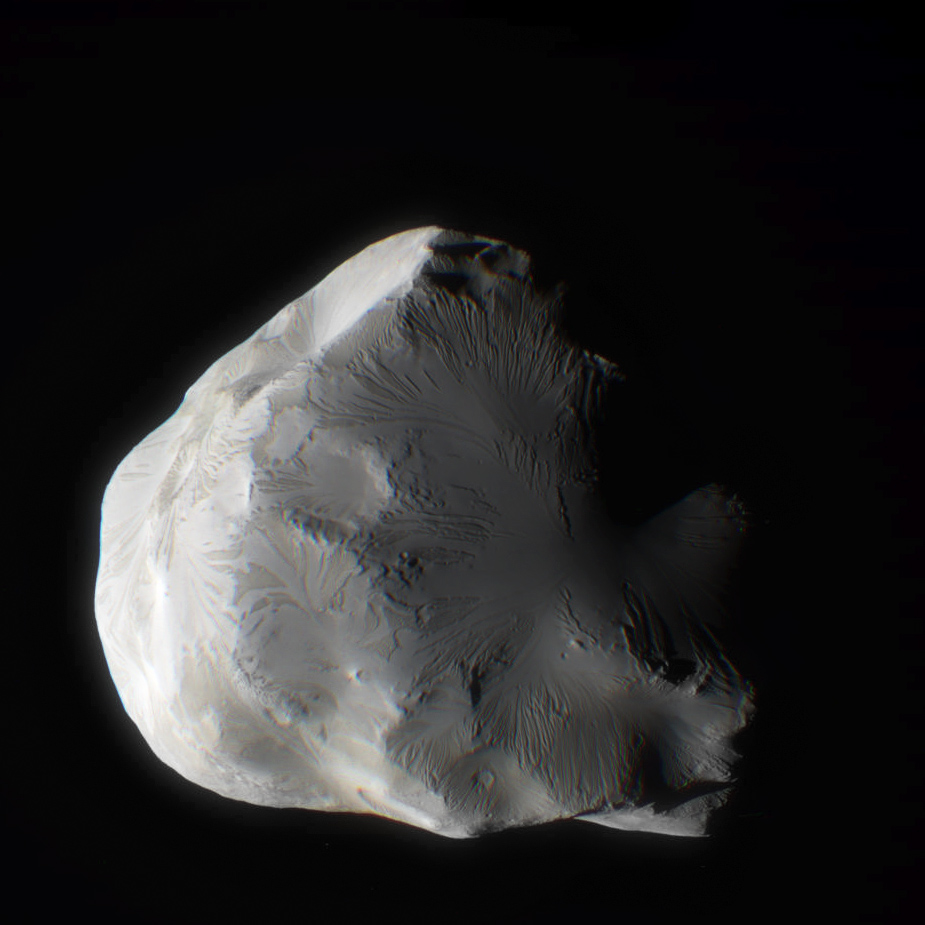
Color composite of Helene from June 18, 2011 flyby. There’s a bit of a blur because the moon shifted position in the frames slightly between images. NASA / JPL / SSI / J. Major

And speaking of tiny moons, the Cassini spacecraft out at Saturn performed a flyby of Helene on June 18. The second-closest flyby of the icy little moon helped to map the surface and better understand the history and gully-like features seen on previous flybys. You can read more about it here.

In other news, the Space Shuttle Atlantis had its final payload delivered on Saturday, June 18. The shuttle is on track for the final flight, STS-135, on July 8. The main payload is the Italian- built “Raffaello” logistics module for the International Space Station, which contains 5 tons of "critical space parts, crew supplies and experiments to sustain space station operations once the shuttles are retired". The secondary payload is dubbed the Robotic Refueling Mission (RRM) – a sort of “gas station in space”.

And finally, tomorrow, June 21, is the longest day of the year for the northern hemisphere, the summer solstice. Hopefully everyone enjoys their long and warm day. Though consequently, it is the shortest day in the southern hemisphere, so keep warm guys.


Wednesday, June 1, 2011

June 2011 Highlights

As with previous months, I am delivering another summary of the great astronomical events you can expect this upcoming month. It definitely feels like Summer here, the Sun doesn't set until nearly 8:30 pm, and the heat has been sweltering this past Memorial Day weekend. All the more reason to spend more of the day at the pool and go out in the cooler evenings to take a look at the stars.

June 1: New Moon: The Moon will be directly between the Earth and the Sun and will not be visible from Earth.

June 1: Partial Eclipse of the Sun: The partial eclipse will be visible in most parts eastern Asia, Alaska, northern Canada, Greenland, and other high latitude locations in the northern hemisphere. Begins at 19:25, ends at 23:06 UT. (UT stands for Universal Time, equivalent to Greenwich Mean Time)

June 9: First Quarter Moon: The Moon is halfway through the waxing phase, a great time for observing as the shadows provide wonderful contrast.

June 10: Saturn & Moon Conjunction: In the evening sky, you can expect to find Saturn and the Moon near each other.

June 13: Mercury at Superior Conjunction: Mercury swings around the opposite side of the Sun and passes into the evening sky.

June 15: Full Moon and Total Lunar Eclipse: Begins at 19:22 UT and ends at 21:03 UT. Mid-eclipse at 20:13 UT. Partial phases begin at 18:22 UT and end at 22:02 UT. The Moon will appear red-orange in color during totality (the Earth's shadow). Total eclipse visible from eastern South America, Africa, Europe, central Asia, and western Australia. This moon, in the Native American tradition of naming the full moons throughout the year, is known as the Strawberry Moon, because this is the time of year when strawberries are naturally in season.

June 21: June (Summer) Solstice: Summer is definitely here for the northern hemisphere! In the southern hemisphere, it is Winter. The Summer Solstice occurs when the Sun reaches the point farthest north of the equator (the Tropic of Cancer at 23.44 degrees north latitude) marking the start of summer in the northern hemisphere and winter in the southern hemisphere. It is also the longest day of the year for the north, while the shortest for the south.

June 23: Last Quarter Moon: Halfway through the Moon's waning phase, The next New Moon will be July 1st.

I'm going to be enjoying my long, warm June days. And you guys in the south keep warm, you'll be rubbing it in our faces come December. Have a great month everyone!