Showing posts with label Space Shuttle. Show all posts

Friday, July 22, 2011

I Guess I Should Stop Being Lazy

I have been back home from my vacation since Monday, but haven't felt much like writing a post. First it was because I was a bit sad leaving the beach and my girlfriend. And then when trying to come up with something in the past few days, there has just been an overwhelming amount of astronomy news that it was hard to pick where to dig into.

Anyways, I am back. You can expect normal posting to resume Monday. I'll probably be checking out the blogs that I follow this weekend. I dunno how much I will get back into it though, I am still working on that job hunt.

But for some weekend reading, here are some of the big astronomy stories that I haven't taken the time to tackle:

The next Mars Rover, Curiosity, had its landing site chosen, Gale crater.

The Dawn probe entered orbit around asteroid Vesta on the 15th, our first close glimpse is amazing.

A fourth moon has been discovered around Pluto. Right now it seems like they are leaning towards naming it Cerberus, the 3-headed dog that guards the gates of The Underworld.

The House has proposed cancelling the James Webb Telescope, described as the Hubble successor (it doesn't really do the same thing, but it's still amazing). The telescope is over 50% done, probably closer to 75-80% and would be in orbit by 2015. Along with a 9% total cut to NASA's budget, with the shuttles winding down, this is like a sucker punch to NASA, an insult. Hopefully the Senate and President alter this course.

Yes, we are officially living in a post-space shuttle world right now. Atlantis landed safely at 5:56 AM EST on the morning of the 21st. Hopefully the post-space shuttle world is temporary and a replacement unveiled soon.

With the space shuttles grounded, the private space race has been heating up. This provides some optimism for the future. NASA can focus on pushing the boundaries that they have done so well while leaving the trucking to someone else.

Also, July 18th was former astronaut John Glenn's 90th birthday. The 20th was the 42nd anniversary of the Moon landing.

There might have been a few other interesting things I missed over, but the major focus has been on the winding down of the shuttle mission. I hope you all have a good weekend!


Friday, July 8, 2011

Final Space Shuttle Launch

Atlantis is set to launch in roughly 2 hours from this posting, at 11:26 AM EST. I am going to the beach to hope to catch a glimpse of it as it soars on its final mission into space. If you want to watch it live online, I suggest going here: http://www.ustream.tv/nasahdtv

This is hoping that the weather clears up. It stands at a 30% chance of a 'go', 70% that it will get delayed. The good thing is that they have back up launch dates Saturday and Sunday, so it will go up this weekend. If anything, good luck to the brave astronauts on this momentous occasion.

I have been thoroughly enjoying my time in the Outer Banks, sorry for the lack of updates... OK, no I am not, it's my vacation. Anyways, I will be back home next Friday. There are plenty of updates to share, and lots of missed astronomy news. I can say that seeing the Milky Way in the middle of the night on Okracoke Island was one of the most awesome moments of my life. It was the most vivid I have ever seen it, and I shared that moment with someone I love. Good times.


Tuesday, June 28, 2011

Preparing for Final Flight

The last space shuttle mission is about a week and a half away. The Space Shuttle Atlantis is gearing up for launch on July 8th. The 'Final Four' astronauts are on site and conducting practice runs while Atlantis is being a thorough examination in preparation for launch.


But Atlantis sure does look amazing in the morning light. NASA recently released the above photo of the Sun rising behind Space Shuttle Atlantis, taken on June 23rd.

Meanwhile, the crew of STS-135 (the designation of this final mission) have been hard at work. The 'Grande Finale' of NASA's shuttle program is approaching fast. This is one time where we do not want 'bombs bursting in air.' The end of the Shuttle Era is less than a month away.

STS-135 crew at a Q&A session with journalists at base of Launch Pad 39A, Kennedy Space Center. From left; Mission Specialists Rex Walheim and Sandy Magnus; Pilot Doug Hurley and Commander Chris Ferguson. Credit: Ken Kremer

It is an uncertain time in human space exploration and no one is going to be expected to preform higher or undergo more scrutiny than these four brave people. The STS-135 team consists of Commander Chris Ferguson, Pilot Doug Hurley, and Mission Specialists Rex Walheim and Sandy Magnus.

In a bittersweet moment, Commander Ferguson has this to say to journalists greeting the astronauts; "We are incredibly proud to represent this, the final flight. I speak on behalf of the crew, everyone in the astronaut office, and I’m sure everybody here at KSC in saying that we are just trying to savor the moment. As our children and our children’s children ask us, we want to be able to say, 'We remember when there was a space shuttle.'"

After three decades of missions, it will be sad to see the shuttles retired. But, we can hope it is not a permanent set back. We have barely tested the vast ocean of space, merely gotten our feet wet. Plans are being made for much needed replacements. The shuttles have provided a wonderful amount of workforce, but they are not without fault, as the multiple delays have shown. It is even likely that Atlantis will be delayed. Hopefully replacements come swiftly and effectively. The plans for new capsules right now seems to be working, they are expected to be 300% safer than the shuttles. It is hoped to be a safe and effective means of transporting man to the next frontier.


Monday, June 20, 2011

So Much Science, So Little Time

I hope everyone enjoyed their Father's Day weekend, I know I had some good times with my family. There has been some great astronomy stuff happening (as always) so I figured I'll dump some links.

This hemispheric view of Venus was created using more than a decade of radar investigations culminating in the 1990-1994 Magellan mission, and is centered on the planet's North Pole. This composite image was processed to improve contrast and to emphasize small features, and was color-coded to represent elevation. Image Credit: NASA/JPL/USGS

First up, Life's Little Mysteries is presenting The Greatest Mysteries of the Cosmos every Friday this summer. They are starting with our solar systems and first was The Greatest Mysteries of Venus. It is a great opener to understanding out planetary evil twin.

Dawn captured this view of Vesta on June 14, 2011. Credit: NASA / JPL-Caltech / UCLA / MPS / DLR / IDA

NASA's Dawn spacecraft is getting closer and closer to asteroid Vesta by the day. It now has a better resolution than the Hubble Space Telescope. The image above was taken on June 14, 2011 from a distance of about 265,000 kilometers. Each pixel spans roughly 25 kilometers. As The Planetary Society explains it:
There's clearly a deep crater in the northern part of the image. And the outline is definitely lumpier than the outlines of similarly sized bodies in the outer solar system (like Mimas and Enceladus), but we knew that already; the rock that Vesta is made of is able to hold up steeper mountains than the relatively low-strength ices that outer planet moons are made of. Apart from that, it's still hard to tell what's albedo differences and what's topography. But that won't be true for long.


In the skies of Mars, there was recently an amazing alignment. On June 1, Mars' tiny moon Phobos slipped in front of Jupiter from the view point of the ESA’s Mars Express orbiter. Above is an animation of the event, using photos taken with the Mars Express’ High Resolution Stereo Camera (HRSC). In addition to being a cool event, the observation also helps to improve knowledge of the martian moon's orbital position.

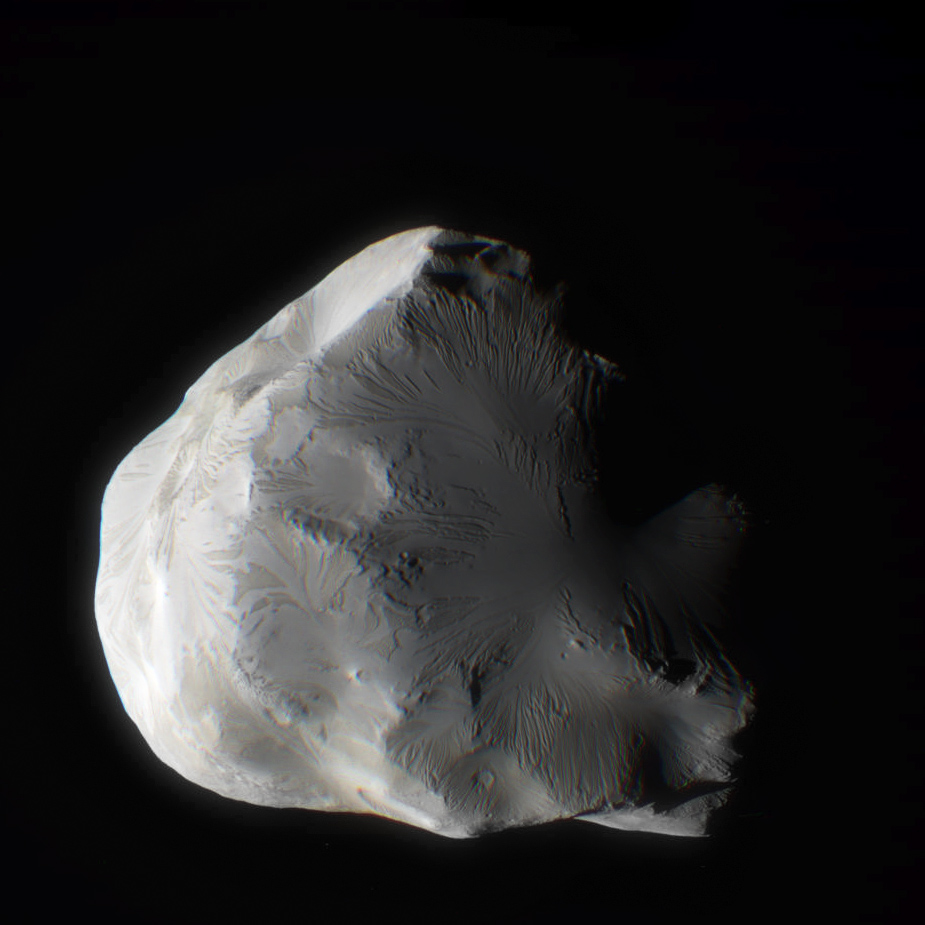
Color composite of Helene from June 18, 2011 flyby. There’s a bit of a blur because the moon shifted position in the frames slightly between images. NASA / JPL / SSI / J. Major

And speaking of tiny moons, the Cassini spacecraft out at Saturn performed a flyby of Helene on June 18. The second-closest flyby of the icy little moon helped to map the surface and better understand the history and gully-like features seen on previous flybys. You can read more about it here.

In other news, the Space Shuttle Atlantis had its final payload delivered on Saturday, June 18. The shuttle is on track for the final flight, STS-135, on July 8. The main payload is the Italian- built “Raffaello” logistics module for the International Space Station, which contains 5 tons of "critical space parts, crew supplies and experiments to sustain space station operations once the shuttles are retired". The secondary payload is dubbed the Robotic Refueling Mission (RRM) – a sort of “gas station in space”.

And finally, tomorrow, June 21, is the longest day of the year for the northern hemisphere, the summer solstice. Hopefully everyone enjoys their long and warm day. Though consequently, it is the shortest day in the southern hemisphere, so keep warm guys.


Saturday, May 28, 2011

Space News With Lots of Pictures.

Lots of astronomy stories have been published in the past week, and I've been rather busy trying to keep track of them all. The best things about these stories, and about astronomy in general, are the pictures. They can tell so much and most of them look beautiful. So, I've rounded up a bunch of the amazing pictures published in the past week or so, and will probably give a short paragraph about them:


Lets start with the star that changed the Universe. The Hubble telescope viewed this variable star that actually resides in another galaxy, our neighbor, Andromeda. Before this star was discovered, the fuzzy patches of galaxies were just called nebula, and thought to be just gas inside our own galaxy. Edwin Hubble (the Hubble telescopes namesake) changed all that in 1923, discovering that these nebula were indeed other galaxies, and used this variable star to determine that they were millions of light years away. You can read the historic story here.

Image Credit: NASA/JPL/Space Science Institute
NASA released these amazing raw images taken by Cassini of Saturn's moons Titan and Enceladus. These images, haven't been processed or colorized yet, but absolutely blow my mind. A couple of the highlights can be seen here, while the full set is over here.

Image Credit: Gemini Observatory/AURA/Andrew Levan

Probably the most distant object ever seen, for now. This is a gamma ray burst, known as GRB 090429B. I made a post about GRBs awhile ago. If you want to know more about the science behind how this sort of stuff is determined, Bad Astronomy has got you covered. And here is the original story with a link to the paper.


WISE, the Wide-field Infrared Survey Explorer, was turned off awhile ago, but the work still goes on. NASA released a gallery of nine spiral galaxy images taken by WISE. For more info on each galaxy, check out the NASA release. (There is also a really huge version of the image, which is drool inducing.)

Docked Endeavour at ISS through a fish-eye lens. Image Credit: NASA

Photos from the last space shuttle spacewalk, it also marked the formal completion of the U.S. segment of the International Space Station. You can go through the entire photo set here.

Image credit: NASA/JPL-Caltech/University of Toledo
This graphic illustrates a stellar fountain of crystal rain, beginning with a Spitzer picture of the star in question, and ending with an artist's concept of what the crystal "rain" might look like. The full article is here.

Of course, there are a couple of stories out there that just really don't have good pictures to go with them. A few of them I suggest checking out are: New arm discovered in outer edge of the Milky Way Galaxy; The Moon is wetter then we thought; For Mars, rapid formation stunted growth; and Info on OSIRIS-REx, NASAs new science mission to asteroid launching in 2016. Have a good Memorial Day weekend to everyone in the U.S. Everyone else, just have a good weekend.


Monday, May 23, 2011

Atlantis on Deck

With Space Shuttle Endeavour in space completing its final missions, the shuttle Atlantis has been moved in to the Vehicle Assembly Building (VAB) in preparation for the final shuttle mission, STS-135, on July 8 around 11:40 AM EDT.
Atlantis rolls over from the Orbiter Processing Facility (OPF-1, at right) processing hanger to the Vehicle Assembly Building (VAB, at left) at KSC for the STS-135 mission. Credit: Ken Kremer

A wonderful set of photos has been uploaded of this transition. You can really see some of the wear and tear on the shuttle. You also get an impression of the massive scale of things. You can find another set here.

The all veteran STS-135 crew poses with Atlantis during rollover to the VAB. Credit: Ken Kremer

If you don't know much about the VAB, located at Kennedy Space Center in Florida, here are a couple facts:
  1. It's the fourth largest building in the world by volume
  2. The largest single-story building in the world
  3. Originally built to allow vertical assembly of the Saturn V rocket for the Apollo program, the space shuttles were designed around the building's doors.
  4. The painted American flag on the building's exterior is one of the world's largest, the blue area is the size of a basketball court and each stripe is the width of a standard road lane.
  5. The building has withstood several direct encounters with hurricanes and tropical storms with minimal damage, with a foundation consisting of 30,000 cubic yards of concrete and 4,225 steel rods driven 160 feet into limestone bedrock.
  6. The four doors to the bays inside the building are the four largest doors in the world. At 456 feet (139.0 m) high, it takes 45 minutes for the doors to completely close or open.
  7. The building is so vast inside, it has its own weather. Rain clouds have formed beneath the ceiling on very humid days. The air can be completely replaced in an hour to keep moisture under control.
Aerial view of the VAB. Credit: NASA

As you can see, the building itself is a technological marvel and an asset to the space program. Despite the end of the shuttle missions, the building will remain a key asset. It will continue to be used in the assembly of rockets for space missions. For further reading on the VAB, check out NASA's page on it, or its Wikipedia article.

P.S. I had mentioned that our cat, Bella, was in the animal hospital. Things looked bad, so we made the tough choice. She is no longer with us, and I will miss the sweet little darling, it is part of life though. We were able to say our goodbyes before she went, which is a relief, if heart-breaking.


Saturday, May 21, 2011

Saturday Space News!

Another Saturday with a couple more news stories! I hope you all are having a great weekend. We're having our 'horse party' for the Preakness race here in Maryland today. So it's a good day to relax, sip on something cool, and enjoy the Universe. And once again, it appears the Rapture has disappointed.

So in astronomy news this past week, there are a couple of stories of interest:

First up, NASA set the launch date for the final space shuttle flight. Space Shuttle Atlantis is targeted to lift off on July 8 around 11:40 AM EDT from Kennedy Space Center in Florida. The shuttle will take four veteran astronauts to deliver supplies and spare parts to the International Space Station. It will also deliver experimental equipment to test robotically refuel and service satellites in space. Given the shuttles recent history, this launch date can be expected to be delayed.

Illustration showing that dark energy (represented by purple grid) is a smooth, uniform force that now dominates over the effects of gravity (green grid). (Credit: NASA/JPL-Caltech)

Next, Astronomers now have a better understanding of Dark Energy and Gravity. A survey of 200,000 galaxies confirms that dark energy is driving the Universe apart at accelerating speeds. The survey, GALEX, used data from NASA’s space-based Galaxy Evolution Explorer and the Anglo-Australian Telescope on Siding Spring Mountain in Australia. The force is seen to be constant and uniform across the Universe. Dark energy is thought to dominate the Universe, making up about 74 percent of it, though what drives and the actual nature of dark energy is still poorly understood. (Additional source)

Astronomers have discovered a new class of planet. The 10 discovered planets are all free-floating, not orbiting a star, and about the size of Jupiter. These 'orphan planets' are about 10,000 to 20,000 light-years from Earth and indicate that a wide-range of these planets exist, perhaps more common than stars. There are expected to be hundreds of billions in the Milky Way, ranging across all sizes, including Earth-sized ones. The ones detected are at the limit of current technology, the smallest possible objects they could detect, using gravitational lensing techniques. The planets initially form around stars, and become orphaned due to gravitational interactions with other planets that force them out of the system. Smaller planets would be easier to influence, making it likely that small planets are more numerous in interstellar space then these large ones. It is even possible that our solar system has lost a planet or two due to this process. A lost brother out in space, as it were.

Voyager 2 (Credit: NASA)

Not really news, but still pretty awesome. You can follow the Voyager 2 space probe on Twitter. It provides real time updates of the probe and its sister, Voyager 1, of their distance from the Earth, chronicling their journey into interstellar space. (As of their last update, Voyager 2 is 13 hrs 08 mins 50 secs of light-travel time from Earth and Voyager 1 is 16 hrs 06 mins 58 secs)

And this one isn't even really astronomy related, but my friend Leroy, who I've mentioned before, is going on a cross country adventure. He is chronicling his adventure in blog format, and although he hasn't posted anything yet, it should be work checking out: The Life and Times of a Modern Day Gypsy.

Bella, wishing her the best.
In a bit of sad personal news, our cat Bella is in the animal hospital. She's been having a rough last couple of days. She's about 14 years old, don't really remember for sure, so shes lived a pretty long life. It's just pretty sad that we might be losing my favorite cat in the next day or two. Maybe she will pull through, but the amount of health complications she's having doesn't make me optimistic. At least I got her to purr for me before they took her to the vet, if that was the last time I get to see her.


Monday, May 16, 2011

Successful Endeavour Launch


Space Shuttle Endeavour successfully lifted off into space this morning from Kennedy Space Center in Florida. This is the shuttle's final mission (STS-134), led by mission commander Mark Kelly. The crew will be delivering the Alpha Magnetic Spectrometer to the International Space Station, among other science projects and spare parts.

You can watch the launch below (I attempted to embed the code from NASA's website, if it doesn't work, watch it here):


After nearly a month long delay due to a heater malfunction, the launch went flawlessly. Endeavour is the youngest of the shuttles, built to replace the Challenger, which was tragically lost in a 1986 launch accident. Endeavour saw it's first flight in 1992, almost exactly 19 years ago. After almost two decades of service, the heater malfunction shows Endeavour age and the need for replacements. The other shuttles have been in service for over 30 years.

After Endeavour's final 16-day mission is complete, the shuttle will be cleaned and prepared for public display at the California Science Center, a museum in Los Angeles. The final planned shuttle mission will be STS-135, the final voyage of Atlantis, scheduled for mid-July.


Saturday, May 14, 2011

Astronomy News Update 5/14/11

Originally, a couple of these stories were to have articles of their own on my blog. The whole Blogger going down thing messed up my flow, and since I am limited on what I can post in a day (I try to keep it to one post), I decided to lump them together with some other cool astronomy news. So, I unofficially bring back a 'Caturday News Round-Up!' These are some of the best stories in the astronomical community from the past week or so. Check them out:

Squids in Space: On Space Shuttle Endeavour's last flight, it will be carrying some very special passengers: baby squid. Not just any squid either, they are glowing bobtail squid. They carry a bacteria called Vibrio fisheri which the squid use to generate light to ensure they do not generate shadows that predators might see. The goal of this experience is to build an understand of how "good" bacteria behave in microgravity.

Cross-section of the interior of Jupiter's moon Io. (NASA/JPL/University of Michigan/UCLA)

Magma Ocean Beneath Io's Surface: A new data analysis from NASA's Galileo spacecraft reveals a huge magma ocean beneath the surface of Jupiter's volcanic moon Io. This analysis shows the source of the most volcanically active body in the solar system. Io produces about 100 times more lava per year than all the volcanoes on Earth. The Galileo probe began orbiting Jupiter in the late 1990s, including flybys of Io and other moons, before it was intentionally sent into Jupiter's atmosphere in 2003.

Super-Earth Gliese 581d is in the 'Habitable Zone': While in recent years the idea of a 'habitable zone' has fluctuated in scope, a team of French researchers have come to the conclusion that Gliese 581d could reside in its star's habitable zone. The Gliese 581 system has been a popular place of study as of late because of the possibility of habitable planets, including 581g which would by located well in the habitable zone but existence is debated. 581d is a super-Earth sized planet on the edge of the habitable zone, but a suitable carbon dioxide atmosphere would allow liquid water. More direct observations are beyond the capabilities of current telescopes, but Gliese 581 would a good candidate for future instruments.

Dawn's first glimpse of Vesta - Processed. (NASA/JPL-Caltech/UCLA/MPS/DLR/IDA)

Dawn's First Image of Asteroid Vesta: NASA's Dawn spacecraft has taken its first image of Vesta, the second largest object in the asteroid belt. It is set to enter orbit around Vesta on July 16. The image will help fine-tune navigation during it's approach. After Dawn completes its mission at Vesta, it will leave orbit and head to the largest object in the asteroid belt, the dwarf planet Ceres.

Bacteria Grow Under 400,000 Times Earth's Gravity: This biological finding would expand the definition of the habitable zone once again. These bacteria grew under the pressure of 400,000 times Earth's gravity, which would expand where life might be found. This "hypergravity" is usually found in massive stars or the shock waves of supernovas, and is recreated on Earth using an ultracentrifuge. Two of the species tested were E. coli, a common gut bacteria, and Paracoccus denitrificans, a common soil bacteria.


Friday, May 13, 2011

Blogger Annoyance & Moon Photos

So, as a few of your may have noticed blogger has been an annoyance, being down most of the past two days. I can understand that, updates need to be done, but something seems to have gone terribly wrong with the entire thing.


As it stands now, I lost my Endeavour Launch Update article, I hope that it may be returned... If not, know that Space Shuttle Endeavour is set to have it's final launch at 8:56 a.m. EDT on Monday, May 16. Everything is on course and repairs to the Shuttle's heater system that caused the initial delay have been fixed. After this flight it will go into retirement and be displayed at the California Science Center.

The launch of the Space Shuttle Atlantis has been pushed back to mid-July.

The argument can be made of why retire the shuttles and so forth. Their need for retirement is made obvious by this delay and the previous delays and the all but certain delay of Atlantis. These shuttles are falling apart, they are old, they need replacement. This process was started under the Bush administration, but even in the Clinton administration doubts were beginning to be raised.

As for why there isn't a replacement on hand, it is an unfortunate bureaucratic side effect. There was a plan, the Constellation program that was to design and build new Ares rockets and the Orion space capsule (akin to the Apollo capsule, but larger and more up to date). The program was severely over budget and bogged down by bureaucratic red tape and political pressure. One of the first things the Obama administration pushed was a complete overhaul which rightly cancelled the Constellation program. But rather than throw the baby out with the bath water, the Orion capsule is still being developed and the work on the Ares rockets is being used in further rocket developments. All in all, it's sad that things got off track, but we are hopefully on the right track right now.


So with that cleared up, I have been busy with blogger being down. First, I have been elected to the Board of Directors for the Harford Country Astronomical Society. After only a short year of being with them I have thoroughly enjoyed my experience with them, as I am sure they appreciate my help. Now I get to have some input on the direction of the club as far as outreach events and observing and astrophotography. I am pretty excited and hope to do good for the club, even though every organization has its internal issues and debates.


Next, earlier this week I finally got the piece for my telescope that allowed my camera to be in a position so that it would take focused shots. You may remember about a month ago, I published my first set of (blurry) pictures along with a video of the Moon. Well, I got a new video (below) and a new moon shot(above), as well as a shot of Saturn. Thinks look a lot better being able to focus correctly. Plus I figured some things out with Windows Live Movie Maker that made the video better.


I still have some things to learn. The moon is a fairly easy target, but Saturn was tricky. My telescope doesn't track to well either. I pretty much had to take a video of Saturn and pluck out the best frame for the image I have below. I also need to find the right camera settings for taking images of planets, as it was hard to just get Saturn to resolve an image. (The blue has is from atmosphere, it was slightly cloudy.)


I think that about wraps things up. I am hoping to get better and this and share more of my own images with you in future. The HCAS observatory is off limits due to construction of the next few months, so I probably won't have much in the way of deep sky objects to share, so hopefully this will do.

With my schedule out of whack from Blogger issues, I am trying to consider what I am going to be doing over the next week. Monday will most definitely be devoted to the hopeful shuttle launch, Tuesday another Astro-Lesson, and Wednesday or Thursday will hopefully see my 100th blog post!


Friday, April 29, 2011

Space Shuttle Endeavour's Launch Delayed at Least 72 Hours.

An issue with Endeavour's Auxiliary Power Unit 1 heaters forced the postponement of launch. The APU system provides power to the hydraulic system for the shuttle, the heater's prevent the system from freezing in orbit. The earliest possible launch time would be Monday, May 2 at 2:33 p.m. EDT, but an actual launch time appears tenuous.

NASA launch director Mike Leinbach confirmed in an interview on NASA TV that it would take at least 72 hours for engineers to turn things around. “Today the orbiter is not ready to fly and we always say in this business we will not fly until we are ready and unfortunately we just aren’t ready,” Leinbach said.

NASA TV launch commentator George Diller explains, “There’s not a way to do the kind of troubleshooting we need to do and still be able to stay in a count configuration. So we will be scrubbing for today.”

The external fuel tank (the big orange thing) had just finished being filled when the problem was identified, and the astronauts suited up and half way to the launch pad. The astronauts turned around and headed back to the Kennedy Space Center. The external fuel tank must now be emptied before troubleshooting can begin.

The delay is a disappointment for the hundreds of thousands who came to Florida to witness Endeavour's final flight and second to last of the space shuttles. This includes STS-134 commander Mark Kelly’s wife, Gabrielle Giffords, and President Obama and his family. The President still plans to travel to Cape Canaveral and tour the facilities there.

The launch team will meet soon to put together a plan for a new target launch based on the work that has to be performed. Expect an update with the new launch time sometime soon. Below is the video of Leinbach explaining the scrub:


Thursday, April 28, 2011

Reminder: Endeavour Launch

A view of the shuttle launchpad at Kennedy Space Center as seen by astronaut Mick Fincke flying in his T-38.

The Space Shuttle Endeavour is scheduled for liftoff at 3:47 P.M. EDT Friday and everything looks like a "Go" for launch.

Endeavour is on the launch pad, prepping for its final flight. The flight crew of the mission, STS-134 is on sight, also prepping for flight. U.S. Rep. Gabrielle Giffords is there, after recovering from being shot in the head at a public event in January in Tuscon, AZ. She is supporting her husband and mission commander Mark Kelly. President Obama is also going to attend the launch.

The forecast calls for an 80 percent chance of favorable conditions for the launch. Storms may delay the rollback of the support structure tomorrow, but shouldn't affect the Friday morning external tank fueling.

Endeavour final flight is a 14-day mission to the International Space Station. There it will deliver the Express Logistics Carrier-3, Alpha Magnetic Spectrometer-2 (AMS), a high-pressure gas tank and additional spare parts for the Dextre robotic helper.

More info on the shuttle mission from NASA, and you can watch the launch on NASA TV.


Wednesday, April 20, 2011

Astronomy News Update 4/20/11

There are a couple of astronomy news things this week that I wanted to share. It's all pretty exciting stuff.

But first, let me remind you to vote on the poll in the sidebar. Every Tuesday I give a little lesson in astronomy and I let you, the readers, decide on what I'm gonna write about. There is always room for suggestions, so please make them in any comment thread. A history of previous Astro-Lessons can be found under the Astronomy Topics heading. (Still working on getting that all updated.)

On to the News:

  • Endeavour's last flight scheduled for April 29 
NASA announced today that the Space Shuttle Endeavour's last flight will be on Friday, April 29, at 15:47 EST. A number of notable things will happen this flight: the Shuttle will deliver the Alpha Magnetic Spectrometer-2 to the International Space Station; there will also be the last set of Shuttle astronaut spacewalks (4 in total); and the Commander is Mark Kelly, husband of Congresswoman Giffords, who got shot earlier this year but plans to attend the launch. More at NASA's Shuttle page and watch it live on NASA TV
  • Titan might be hiding a liquid water ocean
I already told you that Titan was one of the Top Moons of the Solar System, and that it had an entire hydrological cycle based on methane with a thick atmosphere, but now the moon is getting even more complex! According to the math, the motions of Titan's orbit and rotation indicate that their is a HUGE subsurface ocean.

There is speculation that this ocean could be yet more methane, but the recent modeling supports a water (H2O) ocean, making it the best fitting hypothesis so far. It isn't a final blow yet though, the only way to know for sure is to get there and start digging. Another explanation could be an interaction with a large comet or asteroid.
  • Pluto has a large poisonous atmosphere 
Ah, Pluto, even though not a planet anymore, the dwarf is still a favorite for astronomers to study, being the most accessible Kuiper Belt Object. Using the 15-meter James Clerk Maxwell Telescope in Hawaii, a British-based team found a strong signal of poisonous carbon monoxide gas in Pluto's atmosphere. They also discovered that rather than the thought height of 60 miles (~1,000 km), Pluto's atmosphere extends at least 1,860 miles (3,000 km), or a quarter of the way to it's largest moon Charon.

The gas would be extremely cold at about -364 F (-220 C), and the atmosphere is likely generated by solar heating. When Pluto is closer to the Sun, parts of the surface would evaporate into a gaseous atmosphere and freeze again as Pluto moved away. Pluto's last closest pass was in 1989 and it takes 248 years to complete an orbit. More on this discovery can be read on Space.com.
  • Hubble is turning 21!
If the Hubble Space Telescope was a human in the U.S., he'd be getting excited about celebrating with a couple cold ones on April 24. Unfortunately, it can't, so I propose having a beer in honor of its long and wonderful service, and wishing it many more great years. A large part of astronomy in today's popular culture is due to this scope, and the name Hubble is known around the world. On April 24, 1990, the Space Shuttle Discovery roared the HST into orbit and astronomy hasn't been the same since. In honor of this, NASA has released a new image of interacting galaxies called Arp 273, taken on 17 December 2010, with Hubble’s Wide Field Camera 3 (WFC3). You can read more about the image (and find a higher resolution) at the Hubble website or Bad Astronomy.


Of course there are lots of other good stories out there, these are just a couple of the great ones. Other stories to check out: Sunspots spawn gigantic solar flare (with a cool video); Black forests could exist on a world with two suns; and Electromagnetic currents link Enceladus and Saturn.


Wednesday, April 13, 2011

NASA Selects Museums to House Retiring Space Shuttles

On Tuesday, April 12th, NASA Administrator Charles Bolden unveiled the winners in the bidding war to become a home to one of NASA's retiring space shuttles. This came on the the 30th anniversary of the first space shuttle flight, Space Shuttle Columbia in 1981; in addition to the 50th anniversary of space flight (the aforementioned Yuri's Night). The winners are:

  • Atlantis will go to NASA's Kennedy Space Center in Florida
  • Endeavour will go to the California Science Center in Los Angeles
  • Discovery will go to the Smithsonian's National Air and Space Museum in Washington, D.C.  
  • Enterprise will go to the Intrepid Sea, Air, and Space Museum in New York 
Two flights still remain before the Space Shuttle Program is officially retired after 30 years. Endeavour STS-134 in late April, and Atlantis STS-135 in late June 2011. Then the shuttles will be transported to their new homes and put on display. I know I plan to go see Discovery once the exhibit opens.

In honor of their 30 years of hard work, NASA has also released this nice infographic: Fun Facts About the Space Shuttle Orbiter


Thursday, February 24, 2011

Last mission of Discovery (STS-133)

The Space Shuttle Discovery just made its 39th and final flight into space at 4:53 PM EST. After much delay (first scheduled to launch in November), it is good to see it get off the ground, but a somber moment in the age of space exploration.

Discovery will be in space for 11 days, manned by 6 astronauts, and providing components for the International Space Station. This includes Robonaut 2, the first humanoid robot in space. I hope the mission goes smoothly and they all make it back to the Earth.

The last scheduled launch is Space Shuttle Endeavour, set for April 19th. Atlantis is tentatively scheduled for launch during the summer, depending on its need and funding.