So the poll was a tie between the Sun and asteroids. I just picked asteroids, and will do the Sun next week while I think of new topics to populate the poll. Honestly, I might go back to the question and answer format I did when I started the blog, at least temporarily. It's funny though, even though I've been wanting to do the asteroids, I am having some problems on thinking of how to get started...
 |
| Artist Concept of the Asteroid Belt. (NASA) |
Astronomers have been studying asteroids for a couple hundred years. The first asteroid discovered was Ceres, in 1801. Now there are over a million asteroids that have been observed flinging like crazy throughout our Solar System. It is estimated nearly 2 million asteroids 1 km or larger reside in the asteroid belt, a region of space between Mars and Jupiter, but other significant populations include Near-Earth asteroids (NEAs) and Trojans. They are left over remnant from the early Solar System and can say a lot about the composition of those early conditions.
The asteroid belt is incredibly diffuse, where spacecraft can fly through it without worry of hitting anything, unlike what may be portrayed in science fiction. The asteroid belt also isn't likely to have been a planet that never formed or got ripped apart by Jupiter, the total mass off the asteroid belt is less than that of our Moon. Collisions do happen between asteroids though, spawning more smaller asteroids, and because they share orbital characteristics and make up, they are grouped into "families." The characteristics of each family also casts doubt on the possibility of planet formation.
 |
| Vesta (left) and Ceres (middle) compared to the Moon (right). (NASA) |
The largest and most massive object in the asteroid belt is the dwarf planet Ceres. For a half a century after it was discovered, it was considered a planet, along with the asteroids Pallas (discovered 1802), Juno (1804), and Vesta (1807). No new asteroid would be discovered for nearly 40 years. With the discovery of more, the term planet fell out of favor (no vote or decision was needed like in the case of dwarf planets.) Asteroid had been used interchangeably with planet to describe these objects from the beginning, and took over to describe these "minor planets." Asteroid literally means star-like, because of the objects initial appearance in telescopes was like that of a star, except they moved like planets.
 |
| The Asteroid Belt (white) and Jupiter's Trojans (green). (Wikipedia) |
Trojans are populations of asteroids that share an orbit with a larger planet or moon, but do not collide with it because they orbit in one of the two
Lagrangian points of stability, L4 and L5, which lie 60° ahead of and behind the larger body. The largest group of these are the Jupiter Trojans, which, though few are currently known, may be as numerous as the asteroid belt. Trojans are also found around Neptune and Mars.
Near-Earth asteroids are ones with orbits that pass close to the Earth's orbit. These asteroids are divided into families: The Atens, usually inside the Earths orbit; The Apollos, which have average orbital radii more than that of the Earth and perihelia less than Earth's aphelion; and the Amors, which have orbits between Earth and Mars and are more like to cross Mars' orbit. As of April 27, 2011, there are 7919 close approach asteroids with
1218 potentially hazardous asteroids. (IAU Minor Planet Center is my source)
Asteroids probably the greatest space-based threat to life on Earth. We know it is a threat from the history of the Earth (see the picture above, part of the reason why I wanted to make this post). Asteroids have had a hand in several mass extinctions, including that of the dinosaurs as evidence from the Yucatan Peninsula crater suggests. It WILL happen again, that factor just being time. I won't even address the whole Asteroid Apophis thing, because it won't hit us. Apophis will get close, even inside the orbits of geosynchronous satellites, but at best, it will be a bright object to watch.
 |
| Asteroid Defense Force... |
But, that doesn't mean NASA and other space programs aren't doing anything. Aside from the actively searching and tracking potentially hazardous asteroids, scientists are hard at work on designing potential defenses. NASA, ESA, the Planetary Society, and Roscosmos (the Russian Federal Space Agency) are all studying possible deflection methods that include ideas such as nuclear bombardment, kinetic impactors, and gravitational tractors.
There are other reasons to study asteroids as well. Near-Earth asteroids may contain resource deposits that could be mined. This is one of the interesting reasons why I support a manned mission to an asteroid. Though returning to the Moon is a nice idea, asteroids would be easier to mine for resources with the lesser gravity. Those resources could be returned to the Earth to make consumer products, or be manufactured in orbit into necessities and spacecraft for further exploration. Mining them would also reduce ecological destruction on Earth. The key result would be that whichever country did this first would become an economic powerhouse and the sole superpower. But hopefully it would spur competition in other nations and more advance into space, pushing humanity into another golden age.
 |
| {Click to Enlarge} Montage of all the asteroid close-ups at this time, to scale. (Planetary Society) | |
But moving back to the subject, the definition of what exactly an asteroid is is something that has yet to be determined. Technically, based on the 2006 IAU decision that created the dwarf planet classification, everything smaller then a dwarf planet is a 'small solar system body', though the term 'minor planet' is still acceptable. These objects have traditionally been classified as asteroids, comets or meteoroids.
Meteoroids are the easiest to define, typically anything smaller than ten meters across. The line between asteroids and comets has blurred with further study of the Solar System though. So much so that a new classification, Centaurs, has entered the vernacular. These exhibit both asteroid and comet behaviors, comets have a tail and coma of gas around them, and typically lie inwards of the Kuiper belt and outside the orbit of Jupiter. Kuiper belt objects have also been labelled "objects" to avoid classifying them as either asteroids or comets. This leaves us with a general working definition of asteroids as being minor planets of the inner Solar System, such as the asteroid belt, Jupiter Trojans, and near-Earth objects.
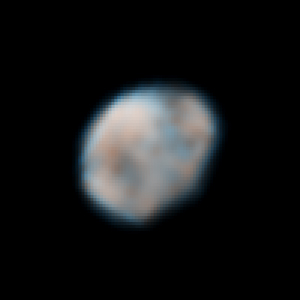 |
| Vesta as seen from the Hubble Space Telescope. (NASA) |
There are a few large asteroids in the asteroid belt that need clarification too. Vesta, Pallas, and Hygiea may be classified as dwarf planets when their shapes are better known. My bet is that they will remain asteroids, but for Vesta, a definitive answer will be reached soon. The NASA Dawn mission is orbiting Vesta this year and reach Ceres in 2015. This will provide much needed information on these objects, the largest two in the asteroid belt. (And hopefully I will right an article on both of them soon, as Vesta has become dear to me.)
 |
| I took this image of Vesta for my university observational astronomy class. |
So there is a basic overlay about asteroids. You can see there are many nuances on this level, and it takes some familiarity to really know about them. There are several different "families" and subgroups, as well as problems with those classifications and how they are determined. But this is all I will leave you with. I hope you learned a lot about asteroids, and you will gain a better understanding on them as more missions are carried out to study them. 9:01 PM
 Astronomy Pirate
 Posted in




 .
.