Totally lied about coming back. Well, I've actually been kinda busy. But I took a video of the Sun, for anyone left following, enjoy it!
 3:32 PM
 Astronomy Pirate
 7:37 AM
Astronomy Pirate
7:37 AM
Astronomy Pirate
9:01 PM
Astronomy Pirate
6:30 AM
Astronomy Pirate
9:56 PM
Astronomy Pirate
 |
| Asteroid 2010 TK7 is circled in green, in this single frame taken by NASA's Wide-field Infrared Survey Explorer, or WISE. Image credit: NASA/JPL-Caltech/UCLA |

 |
| This artist's concept (not to scale) illustrates the first known Earth Trojan asteroid, discovered by WISE. The asteroid is gray and its extreme orbit is shown in green. Image credit: Paul Wiegert, University of Western Ontario, Canada |
8:47 PM
Astronomy Pirate
 | |
| This artist's concept illustrates a quasar, or feeding black hole, similar to APM 08279+5255, where astronomers discovered huge amounts of water vapor. Image credit: NASA/ESA |
2:00 PM
Astronomy Pirate
6:34 PM
Astronomy Pirate
 9:44 AM
Astronomy Pirate
9:44 AM
Astronomy Pirate
11:19 AM
Astronomy Pirate
5:00 PM
Astronomy Pirate
5:00 PM
Astronomy Pirate

 |
| STS-135 crew at a Q&A session with journalists at base of Launch Pad 39A, Kennedy Space Center. From left; Mission Specialists Rex Walheim and Sandy Magnus; Pilot Doug Hurley and Commander Chris Ferguson. Credit: Ken Kremer |
8:40 PM
Astronomy Pirate
 |
| Trajectory of near-Earth asteroid 2011 MD passing Earth on June 27, 2011. Credit: NASA/JPL Near-Earth Object Program Office. |
 |
| 2011 MD on Monday, June 27, 2011 at 09:30 UTC. Credit: Ernesto Guido, Nick Howes and Giovanni Sostero at the Faulkes Telescope South |
2:22 AM
Astronomy Pirate
 |
| On the left, NASA's Solar Dynamics Observatory shows the magnetic rope as the thick looped structure extending above the edge of the sun. On the right, SDO observes as the surrounding cool magnetic field lines are pushed away by the intruding magnetic rope seen on the left. Both images are taken almost simultaneously (within three seconds of each other). [Credit: NASA and GMU] |
5:35 PM
Astronomy Pirate
 2:11 PM
Astronomy Pirate
2:11 PM
Astronomy Pirate
 |
| The Sun as it appeared just a few minutes before today's solstice occurred. (Credit: NASA/SDO) |
 |
| Solstice and Equinox. (Credit: NASA) |
 |
| Solar Analemma over Athens, Greece. The lowest point is on the winter solstice, the highest is the summer, the crossings are the spring and fall equinoxes. (Source) |
2:03 PM
Astronomy Pirate
 |
| This hemispheric view of Venus was created using more than a decade of radar investigations culminating in the 1990-1994 Magellan mission, and is centered on the planet's North Pole. This composite image was processed to improve contrast and to emphasize small features, and was color-coded to represent elevation. Image Credit: NASA/JPL/USGS |
 |
| Dawn captured this view of Vesta on June 14, 2011. Credit: NASA / JPL-Caltech / UCLA / MPS / DLR / IDA |
There's clearly a deep crater in the northern part of the image. And the outline is definitely lumpier than the outlines of similarly sized bodies in the outer solar system (like Mimas and Enceladus), but we knew that already; the rock that Vesta is made of is able to hold up steeper mountains than the relatively low-strength ices that outer planet moons are made of. Apart from that, it's still hard to tell what's albedo differences and what's topography. But that won't be true for long.
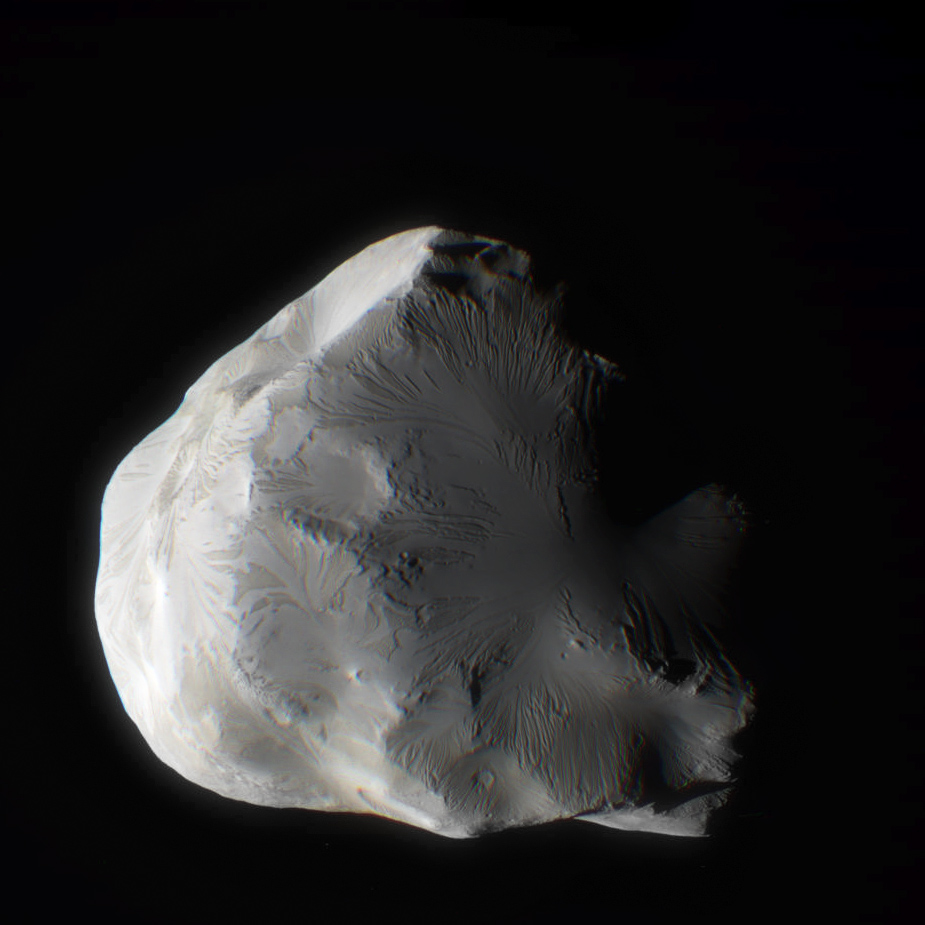 |
| Color composite of Helene from June 18, 2011 flyby. There’s a bit of a blur because the moon shifted position in the frames slightly between images. NASA / JPL / SSI / J. Major |
6:27 PM
Astronomy Pirate
 6:09 PM
Astronomy Pirate
6:09 PM
Astronomy Pirate
 |
| Degas crater imaged as a high-resolution targeted observation (90 m/pixel). Impact melt coats its floor, and as the melt cooled and shrank, it formed the cracks observed across the crater. For context, Mariner 10’s view of Degas is shown at left. Degas is 52 km in diameter. Image Credit: NASA/Johns Hopkins University Applied Physics Laboratory/Carnegie Institution of Washington |
 |
| Major-element composition of Mercury's surface materials as compared to typical lunar surface materials and terrestrial basalts. Mercury appears as unique as the other planets and the Moon. Image Credit: NASA/Johns Hopkins University Applied Physics Laboratory/Carnegie Institution of Washington |
"We are assembling a global overview of the nature and workings of Mercury for the first time and many of our earlier ideas are being cast aside as new observations lead to new insights. Our primary mission has another three Mercury years to run, and we can expect more surprises as our solar system's innermost planet reveals its long-held secrets."
11:36 PM
Astronomy Pirate


 |
| Artist Concept of the Spitzer Space Telescope (NASA) |


 Posted in
 .
.