Showing posts with label Asteroids. Show all posts

Wednesday, July 27, 2011

Earth's First Asteroid Companion Discovered

This is an amazing discovery. Up until now, companion asteroids that more or less share an orbit with Earth have been theoretical. This class of asteroids is known as Trojans; Jupiter has them, and so do Mars and Neptune. Now Earth joins the club with 2010 TK7, an asteroid approximately 300 meters (1000 feet) across and 80 million km (50 million miles) from Earth.
Asteroid 2010 TK7 is circled in green, in this single frame taken by NASA's Wide-field Infrared Survey Explorer, or WISE. Image credit: NASA/JPL-Caltech/UCLA

NASA’s Wide-field Infrared Survey Explorer (WISE) managed to notice the small asteroid. WISE sees in the infrared, where warmer objects are easier to spot. 2010 TK7 is probably about the freezing point of water, which is pretty warm to astronomers. It also orbits such that it is mostly in the sky during daylight hours from Earth, so your typical amateur astronomer isn't going to be able to go out and spot this.

WISE was an asteroid hunting satellite that stopped operating back in February. Astronomers discovered 2010 TK7 by looking through the vast amount of data collected by WISE and confirmed it with Earth-based telescopes. This gives hope that other Earth Trojans might be buried in the data waiting to be found. Where there is one, there may be many.

What makes a Trojan, a companion asteroid, special, is that they orbit what is called a Lagrangian point. Five special spots between two astronomical bodies where gravity is essentially neutral. The points remain stable relative to where the one body is along its orbit around the other. The graph above maps out the locations of where these points would be.

2010 TK7 orbits Earth's L4 point, rather than remaining stable at the point or orbiting the Earth itself. It also has a kind of funky orbit that takes it closer and further away from the Earth, but it is still roughly 60 degrees in front of us and of no danger to the Earth. It just won't ever get close enough.
This artist's concept (not to scale) illustrates the first known Earth Trojan asteroid, discovered by WISE. The asteroid is gray and its extreme orbit is shown in green. Image credit: Paul Wiegert, University of Western Ontario, Canada

It is a tantalizing discovery because it opens the door to several new questions. We know little about this asteroid. It may be a candidate for future exploration, but because of it's odd orbit (it goes well above and below the orbital plane), it would be difficult to reach. But you can bet astronomers are going race to find more Earth Trojans. They have been looking for them for some time already, so it was only a matter of time.

And being an object of some importance, it will also need to be named. Coeus or Crius, the Titan sons of Gaia have been mentioned, but there are other sons of hers. Personally I wouldn't my the cyclopes sons of Gaia; Brontes ("thunderer"), Steropes ("lightning") and the "bright" Arges. But I guess we'll have to see.


Monday, June 27, 2011

Close Call With an Asteroid

Earlier today, (Monday, June 27 2011) at 17:01 UTC (1:01 PM Eastern US time) a small rock, roughly 10 meters in size, and named Asteroid 2011 MD, flew right past the Earth. In fact, if flew really really close to Earth, at about 12,400 km (7430 mi) from Earth’s surface. That distance is less than the diameter of the Earth itself! Or about 1/32 the distance to the Moon. But astronomers were dead on in determining that it would miss us.

Trajectory of near-Earth asteroid 2011 MD passing Earth on June 27, 2011. Credit: NASA/JPL Near-Earth Object Program Office.

It is actually fairly easy to determine where things are heading in space, or at least in the vicinity of our Solar System. The advent of Kepler's laws of planetary motion, along with Newtonian physics and some other neat tricks of the trade, and super computers for crunching the numbers, and really all that is needed is a velocity and a direction. So astronomers generally have a high degree of accuracy on object motion, there are perturbations every once in awhile, but this is usually because of some unseen gravitation interaction.

The biggest threat when it comes with asteroids of this size is the lack of warning. 2011 MD was discovered a mere 5 days before our encounter with it. Now, some people have been claiming that if an asteroid like this were to impact the Earth, it would send a tsunami across the planet twice. Which really just is not true. This was a loose, stony asteroid, like most asteroids, and would have broken up harmlessly in the atmosphere with no ground damage. If anything, it would be a hell of an early fireworks show. The worrisome ones are made up of iron, but aren't very common.

2011 MD on Monday, June 27, 2011 at 09:30 UTC. Credit: Ernesto Guido, Nick Howes and Giovanni Sostero at the Faulkes Telescope South

Of course, it was also a great chance for amateur and professional astronomers to study an asteroid up close. Lately, it's been up to us to send probes and robots to check out asteroids, so it's nice for them to stop by for a visit once in awhile. There have been some great photos posted in this Universe Today article, and Spaceweather.com has a couple of images and movies up. Researchers have also used radio telescopes to study this piece of Solar System history.

Over at Bad Astronomy, Phil Plait wrote an excellent article and suggested that this is the kind of object that future space missions will be looking to explore. It would be relatively easy, easier than getting to the Moon, to put a man on an asteroid like this. Again, the biggest short fall being the lack of warning. But now that we know about this object, and know it will be about another 13 years before it comes this close again, maybe we can have a mission put together by then. Here's hoping to that great future.


Sunday, May 29, 2011

Infographic: OSIRIS-REx

Last week NASA announced its asteroid sample return mission, OSIRIS-REx. It has similarities to a previous mission, Stardust, which collected samples from a comet. The good people over at Space.com put together an infograph for it that you can see below.


Anyways, I feel bad about posting two infographics in the same week, but hey, there's been a lot of news and it's Memorial Day weekend. I reserve the right to dial it in every once in awhile. Oh yeah, OSIRIS-REx stands for Origins-Spectral Interpretation-Resource Identification-Security-Regolith Explorer (isn't that a mouthful), but it certainly is a cooler name then the subject of the previous infographic, the MPCV.


Sunday, May 15, 2011

Impending End of the World

So as you may or may not have heard, apparently Judgement Day is coming this weekend. According to some loonies, the Rapture is going to occur on May 21, 2011. This Saturday.

'Borrowed' from My Own Private Idaho.

Unfortunately they don't give a time, which kind of worries me. I hope it happens at 11:59 PM or something like that. See, Maryland is home to the Preakness, the second race of the Triple Crown (the Kentucky Derby is the first). It also happens to be this Saturday afternoon, which I think is a conflict of interests, as God will be swamped with prayers for Animal Kingdom, Dialed In, Astrology, Midnight Interlude, Mucho Macho Man, and other greatly named horses. And how can he not let a horse name Norman Asbjornson win?

This is 136th Running of the Race

Anyways, this event isn't just about the horses, it has turned into a reason to drink and celebrate the warmer days, like a pre-Memorial Day weekend party. My parents are having a party at their house, which I'm pretty excited about. There will be friends, family, and booze! With plenty of Black-Eyed Susans, the official mixed drink of the race.

A Black-Eyed Susan- Flower, Drink, or a Very Unfortunately Girl.

I also think that the Rapture is kinda boring. It's been claimed to come so many times, it's now like the boy who cried wolf. People always say the end of the world is coming, but there is nothing to it but trying to get people's attention. Not to mention that the guy who made this 'prediction' has failed every other time he has tried to do this. Why do people keep listening to him? Doesn't we know that the Mayans have several centuries on him, and are clearly more accurate? 2012 seems like a much more convenient doomsday for me.

I think the Mayan's would be upset after all the work put into their snazzy calendar.

The fact is that there is NOTHING to worry about. Life will go on, I'm pretty sure most people will ignore this. There is no reason to fear a Rapture or 2012 or any sort of apocalypse of supernatural nature because IT JUST WON'T HAPPEN. The same stuff has been predicted since the beginning of story telling. It gets people to listen, puts fear in them, sometimes this can make them easier to control. Any sensible person can usually see right through this kind of stuff, but there really are idiots out there that believe every 'prophecy' they hear.

Also, like I said, it's boring. Compared to the real threats to life on Earth, the righteous ascending and months of war with demons just seems 'meh.' When we talk of giant rocks smashing into the Earth, or the immense power of the Sun, or a gamma ray burst which would microwave all life off the surface of the Earth, now those are powerful demises that should be feared.

This Book = Awesome.
Luckily those situations are most likely far off. If you would like to learn more about them or others, I would definitely check out Phil Plait's Death From The Skies! Which I also happen to be currently reading and enjoying thoroughly. So enjoy this coming weekend, bet on some horses, and sip on a Black-Eyed Susan (here's a good recipe).


Monday, May 9, 2011

Life on Ceres

I like to look at my stats and see what people are searching for when they come across my blog. A while ago I got a hit from a search for 'Life on Ceres,' and ever since then I have been considering writing a post about it. So this is for you, person out there looking for information about life on Ceres, and hopefully other readers will enjoy this as well.


I had previously glossed over Ceres in my Asteroids Astro-Lesson. Ceres is the largest object in the asteroid belt, and recently got reclassified to a dwarf planet. It is also the smallest known dwarf planet, Pluto (the former smallest planet) is 14 times more massive. And yet Ceres comprises about 25% of the asteroid belt's mass. Ceres is large enough to shape itself into a sphere, at about 580 miles (930 kilometers) across.

But aside from being a unique and astounding body in the asteroid belt, Ceres may have large amounts of water buried under the crust. Astronomers have suggested this because the ex-asteroid's density is less then that of the Earth's crust, because the surface bears spectral evidence of water-bearing minerals. If 25% of Ceres was composed of water, it would have more than all the fresh water on Earth.

The possible internal structure for Ceres. (NASA)

The majority of the water would be ice, forming a mantle around a rocky inner core, with a dusty crust above. It is currently unknown if liquid water exists on Ceres, but a few astronomers suspect there could be oceans. These oceans could be heated by hydrothermal vents and provide a thriving ecology of basic lifeforms.

The problem with this scenario though, is that it is not clear what would keep the proposed oceans in a liquid state. There is no significant tectonic activity (nor enough mass to sustain a long-term molten core) and no significant tidal friction (like with Europa orbiting Jupiter). Although the idea has some merit for consideration, and provides interesting research. We will have to wait until the Dawn spacecraft arrives in 2015 for any definitive answers.

Now, this is where the idea gets a little fun and funky. Supposing Ceres did have a molten core when it and the rest of the Solar System were young, it could have heated an ocean and produced early lifeforms. Well, we know that early Ceres had an active period of bombardment, where meteorites and smaller asteroids impacted and knocked small chunks off. In fact, there is an entire family of asteroids designated C-type because they share similarities with Ceres and many are thought to originate from there. They also happen to be the most common type of asteroid, carbonaceous asteroids.


What I am getting at here is the idea of panspermia, that life in the Universe can start at one place and be transported to others by meteoroids, asteroids, and comets. Ceres has a low escape velocity, so it is not improbably that any early life forms would be kicked off by an impact. That life could have then been transported to Earth, and we could be the descendants.

This is just conjecture. I should put that as a warning, that there is no solid evidence for this hypothesis, but it exists and it is a tantalizing one to discuss. And it is not wholly impossible, but we really don't know. At least not until we find some body whizzing around the Solar System carrying archaic lifeforms most likely in a dormant state. And even if a lifeform made it to Earth, there's no certainty that it survived, life could have already arisen on Earth and devastated the visitor.

The Earth seems to have perfect conditions for life, and must have had sufficient starting conditions. If life was so well at taking hold here, we could it not be formed here in the first place? Then again, maybe there weren't sufficient conditions to start life. Scientifically speaking, there is no clear definition of what caused life to spark into existence on Earth, and panspermia has been a way to address that. But it still neglects the fact that life would have had to have started somewhere at some point in time.


As we get better at understanding biology and Earth's history, this answer is getting clearer. It is now possible, with the right chemical mixtures that relates to the known early atmosphere of the Earth, to generate complex amino acids and other biological components. I suspect we are really only a few years short of understanding the sparking event that unleashed life on Earth, or at least the origin of life somewhere in the Universe if it was brought to Earth.


Tuesday, April 26, 2011

Astro-Lesson: Asteroids

So the poll was a tie between the Sun and asteroids. I just picked asteroids, and will do the Sun next week while I think of new topics to populate the poll. Honestly, I might go back to the question and answer format I did when I started the blog, at least temporarily. It's funny though, even though I've been wanting to do the asteroids, I am having some problems on thinking of how to get started...

Artist Concept of the Asteroid Belt. (NASA)
Astronomers have been studying asteroids for a couple hundred years. The first asteroid discovered was Ceres, in 1801. Now there are over a million asteroids that have been observed flinging like crazy throughout our Solar System. It is estimated nearly 2 million asteroids 1 km or larger reside in the asteroid belt, a region of space between Mars and Jupiter, but other significant populations include Near-Earth asteroids (NEAs) and Trojans. They are left over remnant from the early Solar System and can say a lot about the composition of those early conditions.

The asteroid belt is incredibly diffuse, where spacecraft can fly through it without worry of hitting anything, unlike what may be portrayed in science fiction. The asteroid belt also isn't likely to have been a planet that never formed or got ripped apart by Jupiter, the total mass off the asteroid belt is less than that of our Moon. Collisions do happen between asteroids though, spawning more smaller asteroids, and because they share orbital characteristics and make up, they are grouped into "families." The characteristics of each family also casts doubt on the possibility of planet formation.

Vesta (left) and Ceres (middle) compared to the Moon (right). (NASA)
The largest and  most massive object in the asteroid belt is the dwarf planet Ceres. For a half a century after it was discovered, it was considered a planet, along with the asteroids Pallas (discovered 1802), Juno (1804), and Vesta (1807). No new asteroid would be discovered for nearly 40 years. With the discovery of more, the term planet fell out of favor (no vote or decision was needed like in the case of dwarf planets.) Asteroid had been used interchangeably with planet to describe these objects from the beginning, and took over to describe these "minor planets." Asteroid literally means star-like, because of the objects initial appearance in telescopes was like that of a star, except they moved like planets.

The Asteroid Belt (white) and Jupiter's Trojans (green). (Wikipedia)

Trojans are populations of asteroids that share an orbit with a larger planet or moon, but do not collide with it because they orbit in one of the two Lagrangian points of stability, L4 and L5, which lie 60° ahead of and behind the larger body. The largest group of these are the Jupiter Trojans, which, though few are currently known, may be as numerous as the asteroid belt. Trojans are also found around Neptune and Mars.

Near-Earth asteroids are ones with orbits that pass close to the Earth's orbit. These asteroids are divided into families: The Atens, usually inside the Earths orbit; The Apollos, which have average orbital radii more than that of the Earth and perihelia less than Earth's aphelion; and the Amors, which have orbits between Earth and Mars and are more like to cross Mars' orbit. As of April 27, 2011, there are 7919 close approach asteroids with 1218 potentially hazardous asteroids. (IAU Minor Planet Center is my source)


From the wonderful Saturday Morning Breakfast Cereal.

Asteroids probably the greatest space-based threat to life on Earth. We know it is a threat from the history of the Earth (see the picture above, part of the reason why I wanted to make this post). Asteroids have had a hand in several mass extinctions, including that of the dinosaurs as evidence from the Yucatan Peninsula crater suggests. It WILL happen again, that factor just being time. I won't even address the whole Asteroid Apophis thing, because it won't hit us. Apophis will get close, even inside the orbits of geosynchronous satellites, but at best, it will be a bright object to watch.

Asteroid Defense Force...

But, that doesn't mean NASA and other space programs aren't doing anything. Aside from the actively searching and tracking potentially hazardous asteroids, scientists are hard at work on designing potential defenses. NASA, ESA, the Planetary Society, and Roscosmos (the Russian Federal Space Agency) are all studying possible deflection methods that include ideas such as nuclear bombardment, kinetic impactors, and gravitational tractors.


There are other reasons to study asteroids as well. Near-Earth asteroids may contain resource deposits that could be mined. This is one of the interesting reasons why I support a manned mission to an asteroid. Though returning to the Moon is a nice idea, asteroids would be easier to mine for resources with the lesser gravity. Those resources could be returned to the Earth to make consumer products, or be manufactured in orbit into necessities and spacecraft for further exploration. Mining them would also reduce ecological destruction on Earth. The key result would be that whichever country did this first would become an economic powerhouse and the sole superpower. But hopefully it would spur competition in other nations and more advance into space, pushing humanity into another golden age.


{Click to Enlarge} Montage of all the asteroid close-ups at this time, to scale. (Planetary Society)
But moving back to the subject, the definition of what exactly an asteroid is is something that has yet to be determined. Technically, based on the 2006 IAU decision that created the dwarf planet classification, everything smaller then a dwarf planet is a 'small solar system body', though the term 'minor planet' is still acceptable. These objects have traditionally been classified as asteroids, comets or meteoroids. 
Meteoroids are the easiest to define, typically anything smaller than ten meters across. The line between asteroids and comets has blurred with further study of the Solar System though. So much so that a new classification, Centaurs, has entered the vernacular. These exhibit both asteroid and comet behaviors, comets have a tail and coma of gas around them, and typically lie inwards of the Kuiper belt and outside the orbit of Jupiter. Kuiper belt objects have also been labelled "objects" to avoid classifying them as either asteroids or comets. This leaves us with a general working definition of asteroids as being minor planets of the inner Solar System, such as the asteroid belt, Jupiter Trojans, and near-Earth objects.

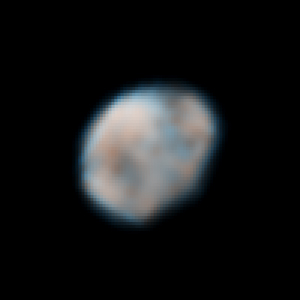
Vesta as seen from the Hubble Space Telescope. (NASA)

There are a few large asteroids in the asteroid belt that need clarification too. Vesta, Pallas, and Hygiea may be classified as dwarf planets when their shapes are better known. My bet is that they will remain asteroids, but for Vesta, a definitive answer will be reached soon. The NASA Dawn mission is orbiting Vesta this year and reach Ceres in 2015. This will provide much needed information on these objects, the largest two in the asteroid belt. (And hopefully I will right an article on both of them soon, as Vesta has become dear to me.)

I took this image of Vesta for my university observational astronomy class.

So there is a basic overlay about asteroids. You can see there are many nuances on this level, and it takes some familiarity to really know about them. There are several different "families" and subgroups, as well as problems with those classifications and how they are determined. But this is all I will leave you with. I hope you learned a lot about asteroids, and you will gain a better understanding on them as more missions are carried out to study them.


Tuesday, April 19, 2011

A Three Way Tie.

The poll for this week ended in a three way tie between Asteroids, Star Life Cycle, and Gamma Ray Bursts. All with 2 votes, out of the 8 voters (the Sun and Pluto/ Kuiper Belt each got one.) I feel that the poll is under performing. I liked the idea of having people express an interest in topics that I could tackle. But with such a low turnout, I wonder if it is even worth it anymore. I might just go ahead and do an article on some astronomy topic every Tuesday on whatever I fancy for the week, or try to address any question posed in the comments.

For now, I am trying to think of what to do about this tie... Thanks guys, you would.

I'll try to put an actual article up tonight, for now, I have voting open again on the three topics. I'll see how it does while I go eat. If that doesn't work, I'll just pick something. The poll is just slightly to the right, at the top of the sidebar, so go vote on the ASTRONOMICAL SUDDEN DEATH ROUND!!!


Friday, March 25, 2011

Farewell to Stardust

This is semi-related to last couple of posts, specifically A Dusty Blog Post and Mercurial Monday. And a bit of a eulogy to a fantastic and amazing spacecraft that provided groundbreaking science for 12 years.

One of the mission's I learned a little bit more about the science behind was Stardust-NExT. A spacecraft that undertook a fascinating mission in comet exploration. The probe is now burning the last of its residual fuel and is being decommissioned about 312 million miles away from Earth.

NASA's Jet Propulsion Laboratory sent these last commands today at about 7 PM EST (March 24). [I found it a sobering moment amongst my birthday celebration.]


Wednesday, March 23, 2011

A Dusty Blog Post

Dust, it's everywhere! From the Earth-based perspective, dust is that layer of film made up of dirt, mostly biological, that settles on things in the corners of your room, or floating in the air reflecting light. On a cosmological scale, dust is made up of a huge variety of materials, literally just about everything in the Universe. And once cosmic dust settles, it forms stars and galaxies.


Cosmic dust also has a pretty large range in size, from just a few molecules up to a couple microns (µm). There really is no upper limit, but after a certain point, things obviously start to become asteroids and comets and meteoroids and such. There is a proposed definition for a meteoroid of being between 100 µm and 10 m across. That would then classify dust any smaller then 100 µm, and starting on a molecular level. Human hair is usually around 100 µm thick.

Cosmic dust can further be distinguished by it's location.