 4:00 PM
 Astronomy Pirate
I like to look at my stats and see what people are searching for when they come across my blog. A while ago I got a hit from a search for 'Life on Ceres,' and ever since then I have been considering writing a post about it. So this is for you, person out there looking for information about life on Ceres, and hopefully other readers will enjoy this as well.

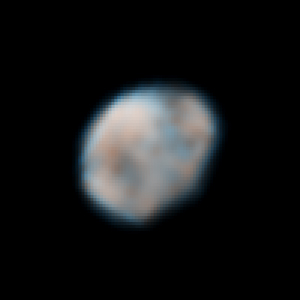
I had previously glossed over Ceres in my Asteroids Astro-Lesson. Ceres is the largest object in the asteroid belt, and recently got reclassified to a dwarf planet. It is also the smallest known dwarf planet, Pluto (the former smallest planet) is 14 times more massive. And yet Ceres comprises about 25% of the asteroid belt's mass. Ceres is large enough to shape itself into a sphere, at about 580 miles (930 kilometers) across.
But aside from being a unique and astounding body in the asteroid belt, Ceres may have large amounts of water buried under the crust. Astronomers have suggested this because the ex-asteroid's density is less then that of the Earth's crust, because the surface bears spectral evidence of water-bearing minerals. If 25% of Ceres was composed of water, it would have more than all the fresh water on Earth.
The majority of the water would be ice, forming a mantle around a rocky inner core, with a dusty crust above. It is currently unknown if liquid water exists on Ceres, but a few astronomers suspect there could be oceans. These oceans could be heated by hydrothermal vents and provide a thriving ecology of basic lifeforms.
The problem with this scenario though, is that it is not clear what would keep the proposed oceans in a liquid state. There is no significant tectonic activity (nor enough mass to sustain a long-term molten core) and no significant tidal friction (like with Europa orbiting Jupiter). Although the idea has some merit for consideration, and provides interesting research. We will have to wait until the Dawn spacecraft arrives in 2015 for any definitive answers.
Now, this is where the idea gets a little fun and funky. Supposing Ceres did have a molten core when it and the rest of the Solar System were young, it could have heated an ocean and produced early lifeforms. Well, we know that early Ceres had an active period of bombardment, where meteorites and smaller asteroids impacted and knocked small chunks off. In fact, there is an entire family of asteroids designated C-type because they share similarities with Ceres and many are thought to originate from there. They also happen to be the most common type of asteroid, carbonaceous asteroids.

What I am getting at here is the idea of panspermia, that life in the Universe can start at one place and be transported to others by meteoroids, asteroids, and comets. Ceres has a low escape velocity, so it is not improbably that any early life forms would be kicked off by an impact. That life could have then been transported to Earth, and we could be the descendants.
This is just conjecture. I should put that as a warning, that there is no solid evidence for this hypothesis, but it exists and it is a tantalizing one to discuss. And it is not wholly impossible, but we really don't know. At least not until we find some body whizzing around the Solar System carrying archaic lifeforms most likely in a dormant state. And even if a lifeform made it to Earth, there's no certainty that it survived, life could have already arisen on Earth and devastated the visitor.
The Earth seems to have perfect conditions for life, and must have had sufficient starting conditions. If life was so well at taking hold here, we could it not be formed here in the first place? Then again, maybe there weren't sufficient conditions to start life. Scientifically speaking, there is no clear definition of what caused life to spark into existence on Earth, and panspermia has been a way to address that. But it still neglects the fact that life would have had to have started somewhere at some point in time.

As we get better at understanding biology and Earth's history, this answer is getting clearer. It is now possible, with the right chemical mixtures that relates to the known early atmosphere of the Earth, to generate complex amino acids and other biological components. I suspect we are really only a few years short of understanding the sparking event that unleashed life on Earth, or at least the origin of life somewhere in the Universe if it was brought to Earth.

I had previously glossed over Ceres in my Asteroids Astro-Lesson. Ceres is the largest object in the asteroid belt, and recently got reclassified to a dwarf planet. It is also the smallest known dwarf planet, Pluto (the former smallest planet) is 14 times more massive. And yet Ceres comprises about 25% of the asteroid belt's mass. Ceres is large enough to shape itself into a sphere, at about 580 miles (930 kilometers) across.
But aside from being a unique and astounding body in the asteroid belt, Ceres may have large amounts of water buried under the crust. Astronomers have suggested this because the ex-asteroid's density is less then that of the Earth's crust, because the surface bears spectral evidence of water-bearing minerals. If 25% of Ceres was composed of water, it would have more than all the fresh water on Earth.
 |
| The possible internal structure for Ceres. (NASA) |
The majority of the water would be ice, forming a mantle around a rocky inner core, with a dusty crust above. It is currently unknown if liquid water exists on Ceres, but a few astronomers suspect there could be oceans. These oceans could be heated by hydrothermal vents and provide a thriving ecology of basic lifeforms.
The problem with this scenario though, is that it is not clear what would keep the proposed oceans in a liquid state. There is no significant tectonic activity (nor enough mass to sustain a long-term molten core) and no significant tidal friction (like with Europa orbiting Jupiter). Although the idea has some merit for consideration, and provides interesting research. We will have to wait until the Dawn spacecraft arrives in 2015 for any definitive answers.
Now, this is where the idea gets a little fun and funky. Supposing Ceres did have a molten core when it and the rest of the Solar System were young, it could have heated an ocean and produced early lifeforms. Well, we know that early Ceres had an active period of bombardment, where meteorites and smaller asteroids impacted and knocked small chunks off. In fact, there is an entire family of asteroids designated C-type because they share similarities with Ceres and many are thought to originate from there. They also happen to be the most common type of asteroid, carbonaceous asteroids.

What I am getting at here is the idea of panspermia, that life in the Universe can start at one place and be transported to others by meteoroids, asteroids, and comets. Ceres has a low escape velocity, so it is not improbably that any early life forms would be kicked off by an impact. That life could have then been transported to Earth, and we could be the descendants.
This is just conjecture. I should put that as a warning, that there is no solid evidence for this hypothesis, but it exists and it is a tantalizing one to discuss. And it is not wholly impossible, but we really don't know. At least not until we find some body whizzing around the Solar System carrying archaic lifeforms most likely in a dormant state. And even if a lifeform made it to Earth, there's no certainty that it survived, life could have already arisen on Earth and devastated the visitor.
The Earth seems to have perfect conditions for life, and must have had sufficient starting conditions. If life was so well at taking hold here, we could it not be formed here in the first place? Then again, maybe there weren't sufficient conditions to start life. Scientifically speaking, there is no clear definition of what caused life to spark into existence on Earth, and panspermia has been a way to address that. But it still neglects the fact that life would have had to have started somewhere at some point in time.

As we get better at understanding biology and Earth's history, this answer is getting clearer. It is now possible, with the right chemical mixtures that relates to the known early atmosphere of the Earth, to generate complex amino acids and other biological components. I suspect we are really only a few years short of understanding the sparking event that unleashed life on Earth, or at least the origin of life somewhere in the Universe if it was brought to Earth.
 Posted in




 .
.